Part 6: The chain of technical and operational consequences stemming from a single wear point
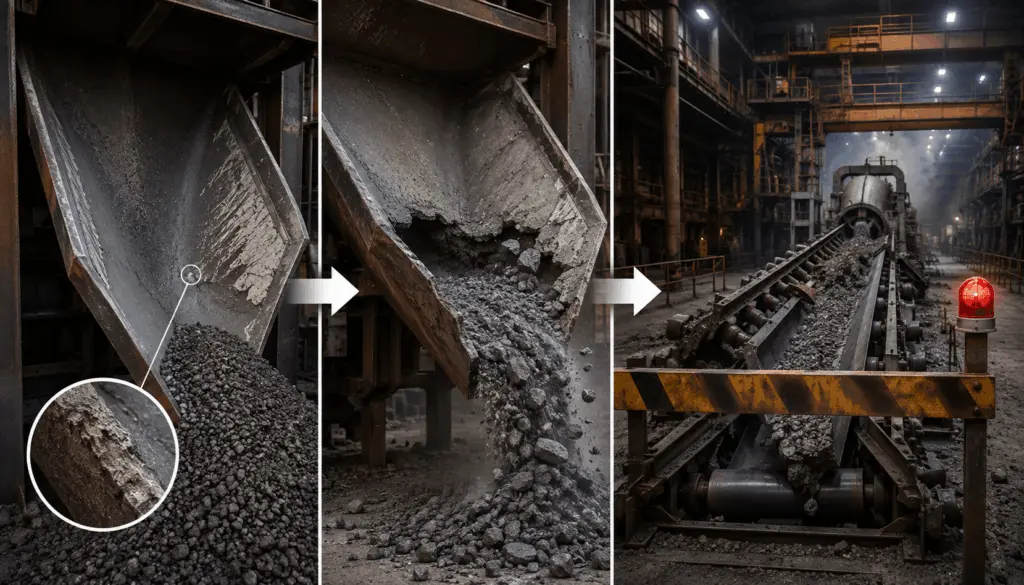
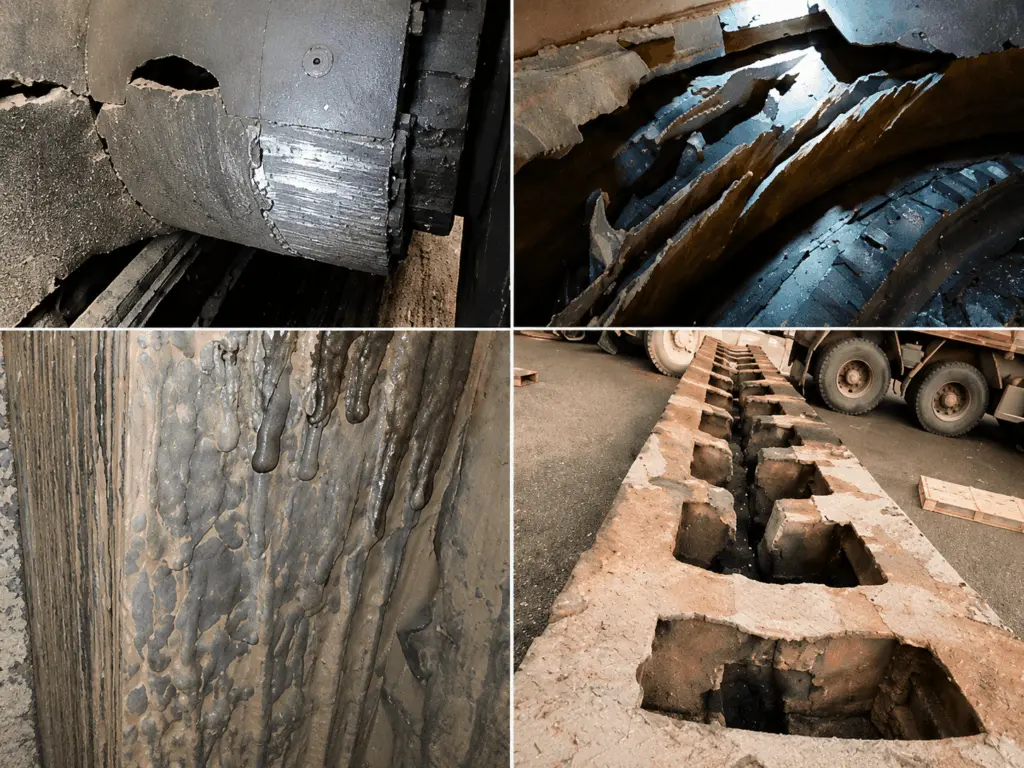
An initial wear point may be regarded as only a minor maintenance item. However, as the clearance continues to increase, vibration appears, or adjacent components begin to fail as well, the impact is no longer confined to the lining plate or the repair at that location.
To properly assess the extent of the impact, it is necessary to consider together the technical progression of the damage, intervention frequency, equipment downtime, less visible cost items, and the possibility that the failure may affect downstream equipment.
Only when these data are brought onto the same time basis or operating cycle does the plant have a basis for determining which location is creating the greater impact and needs to be prioritized for corrective action.
1. A wear point can create three branches of consequences
The impact of a wear location does not appear only in the form of a major failure. Three branches need to be monitored separately:
Within the third branch, three factors requiring attention include:
- labor hours spent inspecting, patching, or addressing the location
- spare materials that need to be maintained because the location fails frequently
- operation below rated capacity to extend the operating time of the equipment
Among these, operating below rated capacity is not a direct cash expense. It represents unrealized production because the plant has to reduce load, and therefore it can easily be excluded from the assessment if only repair costs are considered.
1.1. Costs increase significantly when damage extends beyond the protective layer
The critical transition point in the chain of consequences occurs when the problem is no longer confined to the lining.
When wear causes the clearance to increase, vibration may continue to affect bearings, welds, supports, or adjacent components. At this stage, the scope of work has expanded from replacing the protective layer to repairing multiple parts of the system.
Therefore, at the same location, intervention while the damage is still confined to the protective surface and intervention after the failure has spread into the structure are two entirely different problems in terms of scope and cost.
2. Four data points are required before converting the impact into cost
Before calculating the economic impact of a wear point, four input data points and the party responsible for providing them need to be clearly identified.
Three of the four data points above depend on the specific operating conditions of each plant.
The material supplier should not independently estimate the value of one operating hour, actual downtime, or intervention frequency without confirmation from the plant.
If even one of the input data points is incorrect, the subsequent calculation may also deviate significantly.
3. Operating data can be obtained through five questions
When a complete data table is not yet available, the process can begin with five direct questions to the plant.
The final question is particularly important.
A location that stops only one local item of equipment and a location that forces the entire line to stop can create two very different levels of impact, even if the repair duration is the same.
Therefore, when evaluating a wear point, it is necessary to know not only how long the shutdown lasts but also what scope of the operation must be shut down.
4. Actual impact also includes labor, spare materials, and derating
In addition to the costs that appear directly in a repair intervention, three further issues need to be checked:
- Does the plant need to keep dedicated spare materials for this location?
- Has the production line ever had to be derated to extend the operating time of the location?
- How many labor hours per week or per month need to be allocated to inspection and repair at this location?
Among the three items above, derating is an indication that requires particular attention.
If the plant has to operate below design capacity to prevent a location from deteriorating more rapidly, the impact of the wear point has moved beyond the scope of maintenance and has begun to affect the operating capability of the production line.
Similarly, a location that requires dedicated spare materials to be kept on hand or continuously uses labor for patching is also generating recurring costs even if a major shutdown event has not yet occurred.
5. Fractured lining material can cause additional damage to downstream equipment
Another branch of consequences occurs when a brittle lining cracks and fractures, and fragments of the material continue to travel with the material flow.
These fragments can become new hard particles within the system and act on downstream equipment.
One case in GAC’s survey records involved a coke screen using bonded ceramic lining at a coke-making plant:
The important point in this case is that the consequence did not stop at the screen location. Fragments of the fractured lining continued downstream and created additional effects on the downstream hoppers and chutes.
Therefore, for brittle material groups, one additional question needs to be asked when evaluating risk:
If the lining fractures, in which direction will the fragments travel and which equipment will they encounter next?
This branch of consequences does not apply in the same way to every material group. For metallic materials that primarily wear progressively thinner without producing hard fragments that fall with the material flow, the propagation mechanism will be different.
6. Costs need to be converted to the same time basis
Once the input data are available, direct cost items can be converted to the same time basis for comparison.
Basic formula:
Annual cost = Number of interventions × (Downtime × Downtime value per hour + Labor + Materials)
If the plant already has data for other items such as additional inspection labor, spare inventory, or the impact of derating, these factors can be considered separately alongside the direct costs.
The results can then also be aligned with the plant shutdown cycle or maintenance cycle to match the way interventions are planned.
The method for converting wear-rate data into the number of remaining operating cycles is presented in Part 4: Wear-rate measurement and baseline establishment within the Field Survey, Measurement and Diagnostics knowledge cluster.
The method for placing different options on the same cost table is presented in Part 5: From measurement to economic decision-making within the same knowledge cluster.
7. The same data set produces different decision outputs for different departments
Engineering, procurement, and plant management may use the same data source but have different decision-making objectives.
For engineering, the main question is why the location is deteriorating and what data support that assessment.
For procurement, price per kilogram does not indicate which option results in a lower cost of use if replacement frequency and downtime differ.
For plant management, a location that requires repeated intervention or causes unplanned shutdowns is often more important than the difference in the unit price of the lining itself.
8. Three signs indicate that the impact of a location is greater than the recorded repair cost
Three signs requiring attention include:
- the location has required patching or repair three or more times within one year
- the plant needs to maintain dedicated spare materials for the location
- the production line has had to be derated to extend the operating time of the component
Among these, derating is the strongest indication that the problem has affected operations.
A location that has not yet caused a complete shutdown but continuously forces the production line to operate below capacity may still create a significant impact. If only the number of repairs is considered, this impact will not be fully reflected.
9. Plant data should not be replaced with estimated values
When the hourly production value, actual downtime, or intervention frequency is not yet available, an assumed number should not be inserted simply to complete the calculation table.
A calculation that uses the correct formula but data without a valid basis can still produce an incorrect conclusion.
Therefore, if plant-side data are still unavailable, the missing data need to be clearly identified and supplemented before the result is used for economic decision-making.
This principle is particularly important for the value of equipment downtime, because the level of impact can vary greatly between two production lines or two plants.
10. Responsibilities of the departments
Evaluating the chain of consequences requires a combination of technical, operating, maintenance, and cost data.
The solution provider may support the structure of the calculation table and data analysis but should not independently fill in parameters that belong to the plant’s operating conditions.
The results are only meaningful when the input data have been confirmed from the correct sources.
11. Notes when applying this knowledge
First, the formula in this article is a basic conversion framework for bringing different impacts onto the same time basis. A more complete cost model may also involve depreciation, inventory, production planning, and variables specific to each plant.
Second, impacts such as derating, maintaining spare inventory, or the risk of unplanned shutdown should only be converted into monetary values when sufficiently supported data are available. If they cannot yet be quantified, they should still be recorded as separate factors in the evaluation process.
Third, most input data belong to the plant. When hourly production value, downtime, or intervention frequency is not available, these should not be replaced by externally estimated figures.
A wear point should not be evaluated solely by the price of the material layer that needs to be replaced. Once the damage has resulted in repeated interventions, equipment downtime, spare materials, reduced capacity, or damage to downstream equipment, the scope of impact has extended beyond the wear location itself. Bringing these consequences onto the same cycle helps the plant more clearly determine which locations should be prioritized from the perspectives of engineering, maintenance, and investment.