Material wear mechanisms in industrial plants
A piece of equipment can deteriorate rapidly even after it has just been replaced or while using a material with high hardness. The cause does not lie only in the material itself but also depends on the actual operating conditions at the surface.
Material flow, particle size, impact, temperature, moisture, and the chemical environment can all change the way equipment deteriorates. Even two locations close to each other on the same production line may be subjected to different mechanisms.
Therefore, before selecting a material group, three issues need to be identified: which mechanism is causing the damage at the location, what the operating conditions are at that location, and to what extent the damage is affecting the equipment or production line.
This article provides an overview of GAC’s approach to material wear mechanisms. The content on damage-pattern identification, the effects of temperature, material build-up, common wear locations, and operational consequences is divided into 7 in-depth articles in the following sections.
1. “Wear” does not involve only one mechanism
Many forms of surface damage in industrial plants are commonly grouped under the general term “wear.” However, materials can deteriorate through different mechanisms.
Within this content system, wear is divided into four main groups: mechanical wear, adhesive wear, chemical wear, and fatigue wear. These mechanisms may occur individually or simultaneously at the same location.
Mechanical wear can also occur under different forms of action such as scratching, crushing, or particle-laden flow. Impact and erosion are not separated into independent types of wear but are considered in relation to the mechanism occurring at the surface.
Correctly distinguishing the mechanism from the outset helps avoid situations in which a location is damaged by one mechanism while the solution is selected based on properties suited to another mechanism.
You can learn more about how to distinguish each wear type, the different forms of mechanical wear, and the signs they leave on the surface in Part 1: 4 types of wear and their identifying signs on the surface.
2. Surface damage patterns provide clues for narrowing down the mechanism
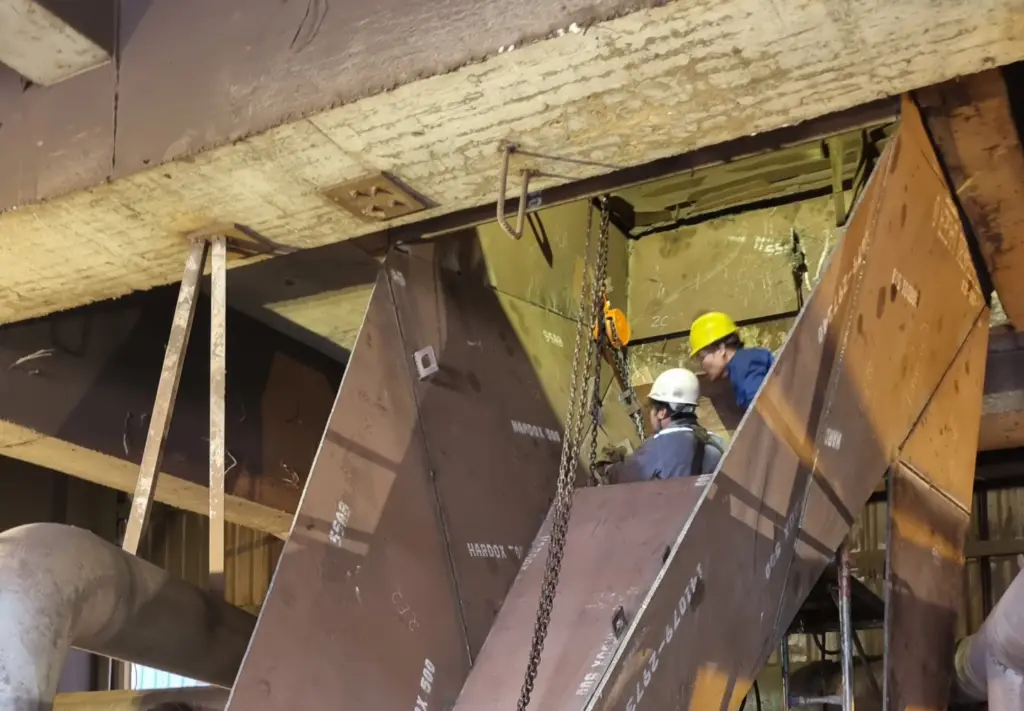
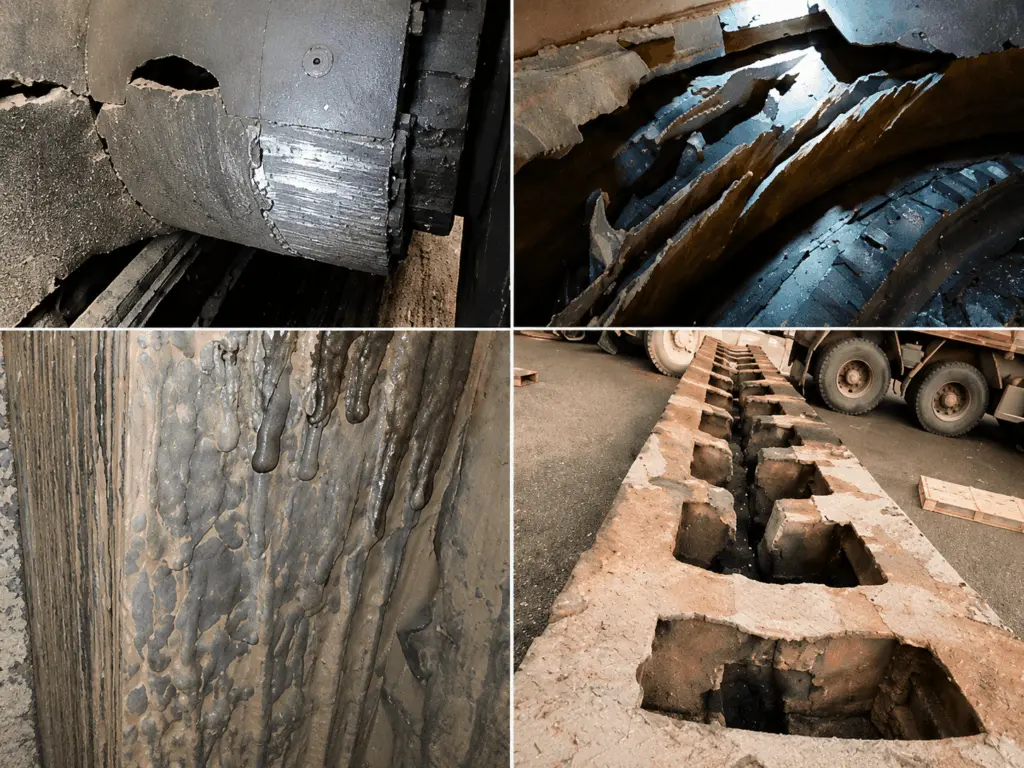
Each mechanism usually leaves different signs on the surface. Therefore, observing the damage pattern is one of the first steps engineers use to identify the group of causes requiring further investigation.
However, damage patterns should not be interpreted separately from operating conditions. Material-flow direction, temperature, particle size, moisture, impact location, and repair history can all change the way the surface deteriorates.
Another important point is that not every visible phenomenon on the equipment belongs to a wear mechanism. Two cases that are commonly confused are:
- material build-up and flow blockage, where material accumulates on the surface instead of the protective layer being lost
- failure at the fastening point, where the liner detaches or falls off even though the material itself has not yet worn through
Distinguishing between the three groups of material loss – material build-up – loss of fastening helps avoid replacing the material when the actual cause lies in material flow or the liner fastening method.
3. Temperature can completely change the range of materials that can be used
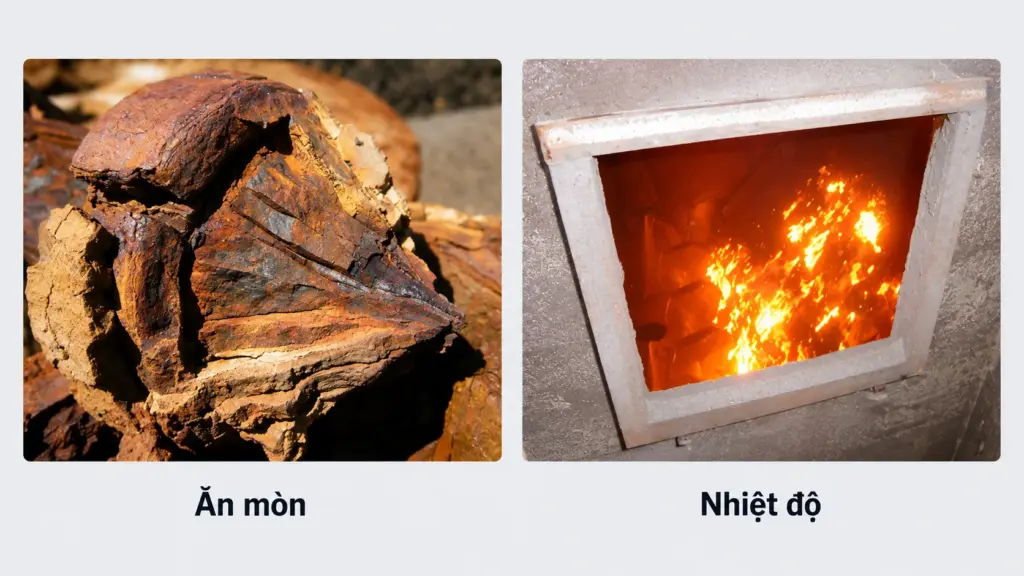
A material group suitable at normal temperatures may not remain suitable as the temperature increases.
The concern is not only the temperature at the time when the equipment is operating under steady-state conditions. The survey needs to distinguish between operating temperature and peak temperature, particularly at locations subject to fluctuations during start-up, overload, or changes in material flow.
Material groups also have different temperature limits. Even within the same group, specific grades may differ significantly in their allowable operating temperatures. Therefore, general temperature thresholds are suitable only for initial screening. When developing a solution, the specifications of the specific material grade intended for use need to be checked.
The mechanisms by which temperature affects material performance, the distinction between operating temperature and peak temperature, and thermal-shock cases are presented in Part 2: Effects of temperature on material operating limits.
4. Material build-up and flow blockage need to be separated from the wear problem
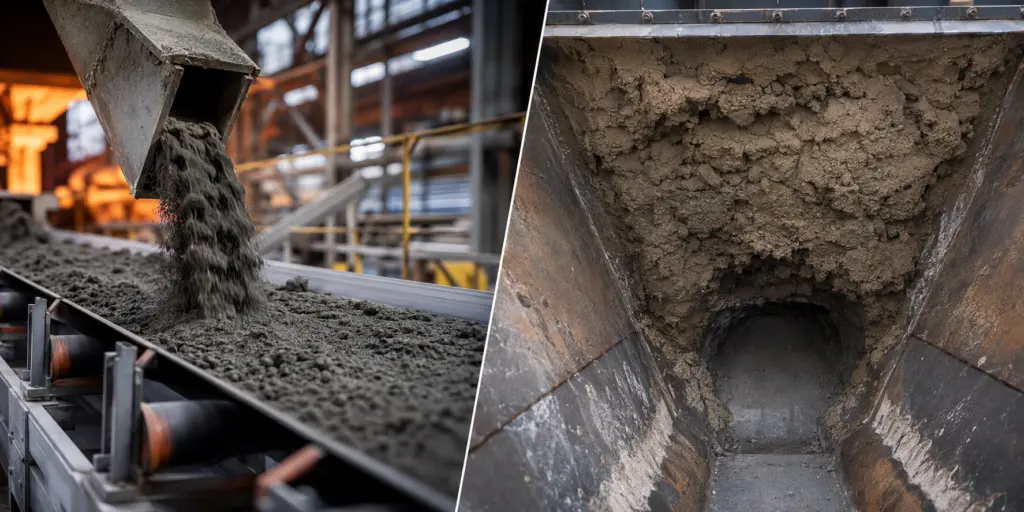
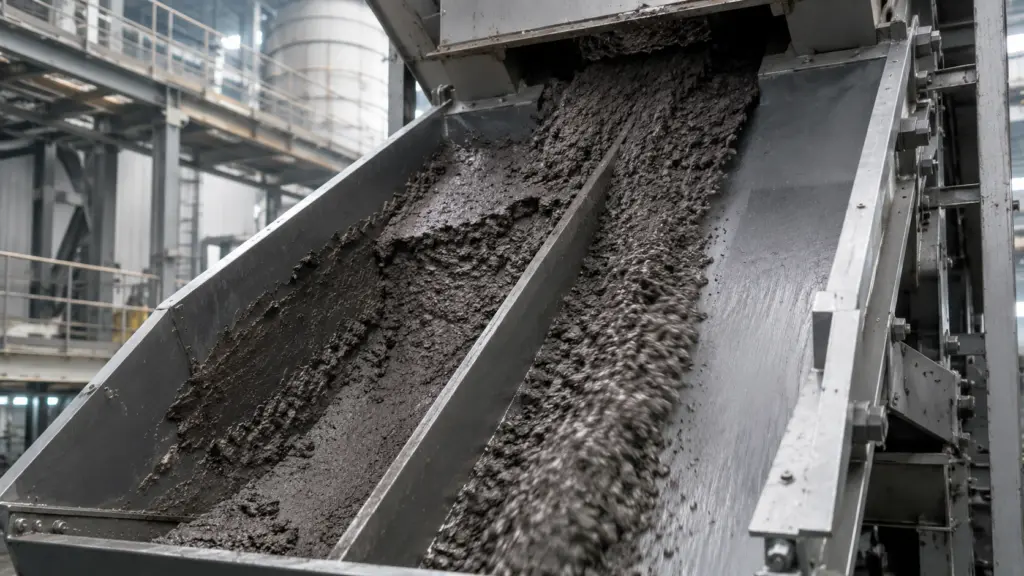
Ore, coal, or other moist bulk materials can build up on hopper walls, form arches, or reduce the material-flow cross-section.
In this case, the substrate material may remain intact while the material flow no longer moves as designed. Increasing liner hardness does not directly address the cause if the actual problem lies in moisture, material characteristics, sliding angle, or material-flow geometry.
This is also why it is necessary to distinguish between:
Material build-up is the phenomenon in which material accumulates and remains on the surface.
Adhesive wear is the phenomenon in which material is transferred from one surface to another when two surfaces are in contact and slide relative to each other.
The two phenomena have similar names but involve different mechanisms and require different approaches.
This content is divided into two in-depth articles:
- Part 3: Material build-up and flow blockage: formation mechanisms and identifying signs
- Part 4: 3 indicators for evaluating material build-up: moisture, stickiness, and sliding angle
5. Damage locations are often concentrated where material-flow conditions change
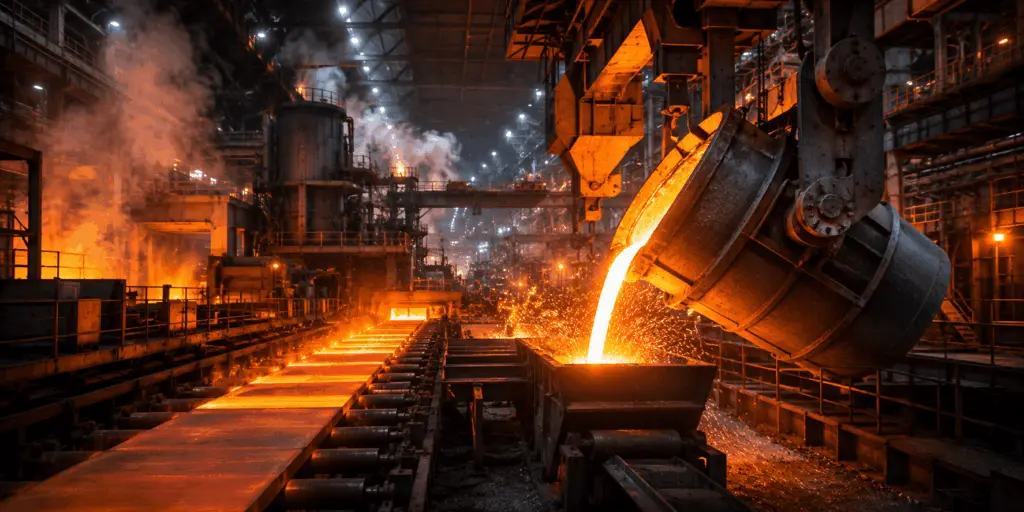
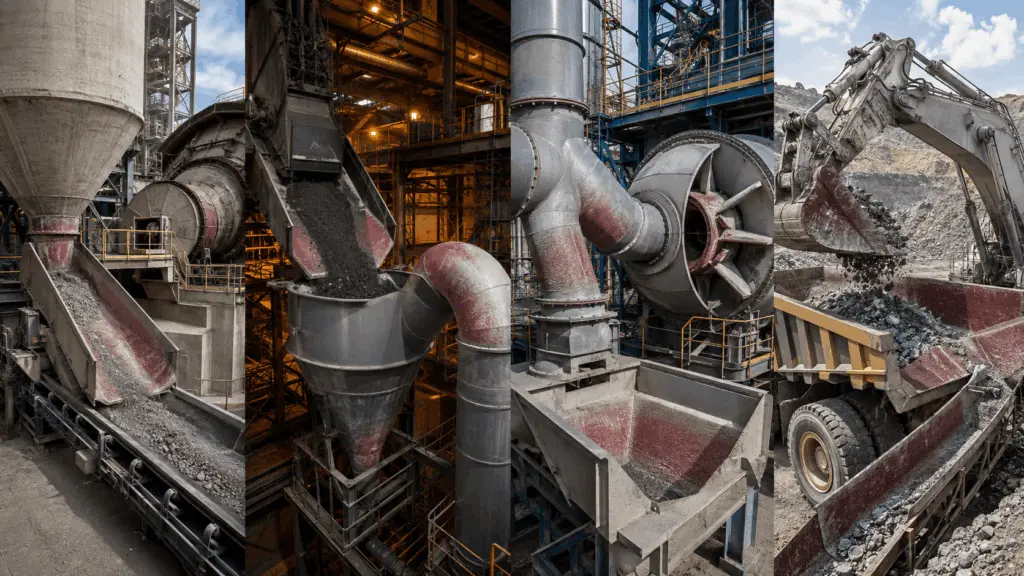
Along a production line, early damage often occurs where the material flow changes direction, changes velocity, drops from a height, or transfers from one item of equipment to another.
Some groups of locations that commonly require attention include:
Even within the same production line, conditions at two locations may differ significantly in terms of temperature, velocity, impact, or environment. Therefore, a location map only helps identify where inspection should be prioritized; it does not replace evaluation of the actual conditions at each point.
Typical locations by industry are presented in greater detail in Part 5: Wear-location map by industry and equipment.
6. A localized failure point can affect the entire production line
The significance of a wear location is not limited to the cost of replacing the liner.
As the damage continues to develop, the affected area may extend from the protective surface to the structure and surrounding components.
A progression may develop as follows:
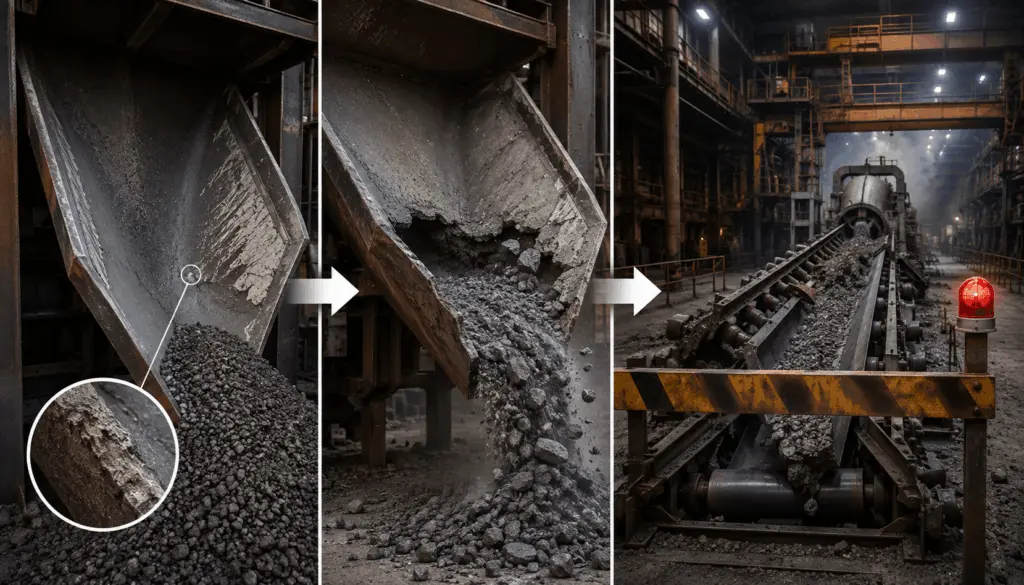
surface deterioration → increased clearance or vibration → adjacent components subjected to additional effects → unplanned equipment shutdown
At that point, the cost is no longer limited to the price of the replacement material but also involves equipment downtime, labor, spare parts, and the impact on production output.
The level of impact also differs between a location that causes only one item of equipment to stop and a location that can lead to shutdown of the entire line.
The quantitative assessment of these consequences is presented in Part 6: Technical and operational consequence chain from a wear location.
7. A location can be subjected to multiple mechanisms simultaneously
In practice, mechanisms do not always occur independently.
A chemical environment may weaken the outermost material layer, after which the particle-laden flow continues to remove the weakened layer and expose a new surface. When the two effects occur simultaneously, the deterioration rate may differ significantly from that observed when each factor is considered separately.
This is why diagnosis should not stop at finding a single term to describe the damage. Engineers need to determine which mechanism is governing and which factors are contributing to the failure process.
Part 1 examines in greater detail how surface damage patterns can be used to identify these cases.
8. System of 7 in-depth articles
The Material Wear Mechanisms knowledge cluster consists of 7 parts. Each article examines one specific issue in depth.
Part 1: 4 types of wear and their identifying signs on the surface
Examines the four types of wear, the forms of mechanical wear, and how to interpret damage patterns on the surface.
The content focuses on locations to observe, damage-mark direction, crack patterns, machining marks, and cases where multiple mechanisms occur simultaneously.
Part 2: Effects of temperature on material operating limits
Clarifies the effects of temperature on material performance.
The article distinguishes between operating temperature, peak temperature, temperature limit, and thermal shock, while also providing guidance on how to avoid incorrectly assessing temperature conditions at the site.
Part 3: Material build-up and flow blockage: formation mechanisms and identifying signs
Separates the material build-up problem from the material-loss problem.
This section helps distinguish wall build-up, arching, and funnel flow, while also clarifying why increasing hardness does not solve every flow-blockage problem.
Part 4: 3 indicators for evaluating material build-up: moisture, stickiness, and sliding angle
Examines in greater detail the data used to evaluate material-flow behavior on a surface.
The focus is on moisture, stickiness, and sliding angle, together with how these measurements are used to compare material-build-up conditions.
Part 5: Wear-location map by industry and equipment
Expands the assessment from a single failure point to the entire production line.
The article compiles locations that commonly deteriorate early in cement, iron and steel, thermal power, and mining applications to help technical teams identify areas that should be prioritized for inspection.
Part 6: Technical and operational consequence chain from a wear location
Tracks the impact of a damaged location from the initial component through to operations and cost.
This section focuses on equipment downtime, intervention frequency, impact on production output, and the extent of the incident.
Part 7: Roadmap for mechanism diagnosis and field assessment
The final article helps determine which cases can continue to be monitored using existing data, which cases require additional surveys, and when the process should proceed to material-group selection.
9. Select an article based on the problem being encountered
10. Common deviations that can lead the diagnosis in the wrong direction
Some initial deviations can lead to incorrect selections in subsequent steps.
The most important deviation is incorrectly identifying the nature of the wear from the outset. When the mechanism is misidentified, the subsequent measurement, material-group selection, and solution-evaluation steps may also proceed in the wrong direction.
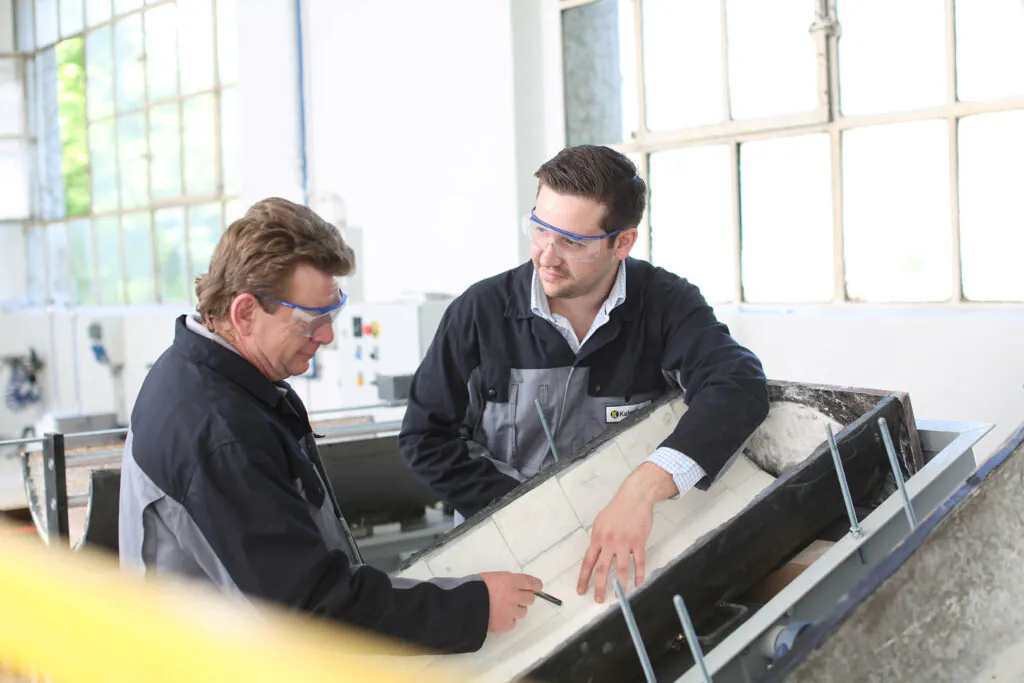
11. From mechanism identification to material-group selection
Three knowledge groups are connected in sequence:
This sequence helps avoid moving directly from a phenomenon such as “rapid wear” to the name of a material.
Mechanism identification determines what needs to be checked. Field survey determines the actual operating conditions. Only then is there sufficient basis to compare material groups.
12. Notes when applying this knowledge
First, two locations on the same production line may be subjected to different mechanisms and temperature conditions. This overview does not replace evaluation at each individual location.
Second, surface damage patterns help narrow down the mechanism but do not directly determine the material group to be used. The selection stage requires additional field data.
Third, the location map only indicates areas that commonly require attention. The actual condition still depends on the equipment, material handled, and operating conditions of each plant.
Fourth, data on equipment downtime and economic losses must be obtained from actual operating data. A common value should not be used across multiple plants.
The wear mechanism is the starting point of the material-selection process, not the endpoint. Correctly identifying the damage mode helps determine what needs to be measured next, while a material decision should only be made after the mechanism, operating conditions, and the level of impact of the location have been considered together.