Part 4: 3 indices for evaluating material adhesion: moisture content, cohesion, and chute angle of slide
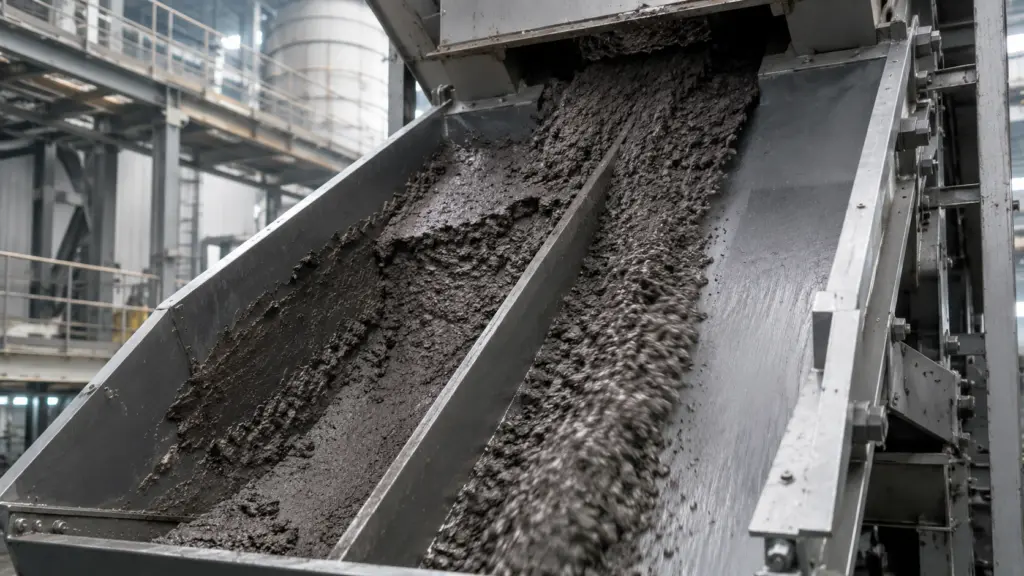
Material sticking is a problem of material flow and the interaction between the material and the surface, not a problem of material being progressively lost through wear. Therefore, the data that need to be monitored also differ from the groups of factors used to evaluate wear.
The three indicators that need to be considered are material moisture content, stickiness, and sliding angle. These three indicators respectively help determine whether conditions are present for a build-up layer to form, how strong the retaining interaction between the material and the surface is, and whether the geometric conditions are sufficient for the material to continue sliding.
Part 3 focused on the formation mechanisms and identifying signs of material sticking, arching, and ratholing. This section examines in greater detail how to measure the three indicators in order to determine which factor should be prioritized for corrective action.
1. Three indicators reflect three aspects of the material-sticking problem
The three indicators need to be considered together rather than evaluated separately.
The problem can be understood through three directions of action:
- reduce the moisture content of the material
- reduce the degree of retention between the material and the surface
- change the angle to increase the sliding capability of the material flow
Therefore, changing the lining affects only one part of the problem. If the primary cause lies in moisture or geometry, changing the surface may slow the accumulation process but may not eliminate the primary cause.
The identification of wall build-up, arching, and ratholing is presented in Part 3: Material sticking and flow blockage: formation mechanisms and identifying signs.
2. Moisture content needs to be measured at both the inlet and outlet
Moisture content is one of the underlying conditions of the material-sticking process.
If only one sample is taken at one time or from one location, it is very difficult to determine whether the condition of the material changes as it passes through the area where blockage is occurring.
If the outlet moisture content is higher than the inlet moisture content, the possibility that the material has absorbed additional moisture while moving through the system needs to be checked.
In that case, the cause may no longer lie solely in the lining surface, and the investigation needs to be expanded to other conditions along the line, such as moisture sources or the condition of the material flow.
This article does not specify a common moisture threshold at which caking begins, because this value depends on the material type and particle condition. Therefore, moisture measurements need to be used for comparison within the actual conditions being surveyed rather than applying a fixed value to every case.
3. Stickiness is evaluated comparatively using a sliding-angle test
Under this method, field stickiness is evaluated comparatively using a comparative sliding-angle test.
The test requires a sample plate of the material group to be evaluated and an angle-measuring instrument.
When the test conditions are kept the same, a lower angle at the onset of sliding indicates that the material begins to move more easily on that surface.
This is a comparative test. The result allows two or more material groups to be compared under the same material conditions, but it does not establish an absolute threshold that can be applied to every location.
The value of the test lies in enabling comparison before direct implementation on the equipment, rather than having to install each material group for trial and then evaluate it through actual operation.
During testing, the amount of material, the method of inclining the plate, and the number of repetitions need to be kept consistent between samples. This article does not specify a fixed standardized set of parameters for these factors.
4. The angle of the sliding surface must be measured at the actual location
The angle should not be taken directly from the drawing and used as survey data.
The actual angle may differ from the design because the equipment has been modified, deformed, or the working surface has changed after a period of operation.
A single point should not be measured and then used for the entire surface if the sliding surface is not uniform.
The build-up layer also changes the geometry actually contacted by the material flow. As the accumulated layer becomes progressively thicker, the angle actually encountered by the material flow may differ from the angle of the original lining surface.
Therefore, in addition to the lining angle, the thickness and distribution of the build-up layer in the same area need to be recorded.
This article does not specify a common minimum angle for each material type. The value needs to be evaluated according to the actual conditions and the results of the corresponding test.
5. Seasonal conditions must be considered together with the three indicators
Moisture content and material condition may change with the season. Meanwhile, moisture content is one of the key data points in the material-sticking problem.
The record should include two groups of information:
- survey timing, including the month, season, and weather conditions at the time the data are collected
- seasonal operating history, including the season with the most frequent blockage, the extent of variation, and the frequency of blockage-clearing interventions
If the survey is conducted during a season with less severe conditions, the data need to be recorded accurately as data from that specific period.
Measurements taken during the dry season should not be automatically extrapolated to rainy-season conditions when corresponding data are not available.
When it is not yet possible to conduct a survey during the season with the most severe blockage, the record needs to clearly state the representative scope of the available data.
6. The form needs to retain sufficient indicators for comparison between surveys
The main data can be organized within the same form:
Thresholds for which there is not yet a basis for general application should not be filled in with estimated values.
The immediate objective of the form is to provide technical personnel with data to:
- compare different points in time
- compare different surfaces
- compare against the actual blockage condition
- determine which factor requires more detailed investigation
Data such as the number of rodding interventions, the number of air-blasting interventions, and labor time reflect the level of impact on operations rather than the three material-sticking indicators themselves.
You can review this knowledge in Part 3: Material sticking and flow blockage: formation mechanisms and identifying signs.
7. Responsibilities of the departments
Measurement of the three indicators requires a combination of field data and information from operations.
The material sample used for the test needs to be taken from the flow that is actually causing the sticking phenomenon, rather than being replaced by a sample from a stockpile if the material condition has changed.
Evaluation of angle and geometry is particularly important when the data indicate that the problem does not lie primarily in the surface.
8. Notes when applying this knowledge
Four points need to remain clear.
First, these three indicators do not have a common set of thresholds that can be applied identically to every type of material and every item of equipment. The values need to be interpreted within the specific conditions of the surveyed location.
Second, the sliding-angle test is a relative comparative test. The result is suitable for comparing surfaces under the same test conditions and does not establish an absolute threshold for the entire system.
Third, thresholds for which there is not yet a basis for determination should be left blank rather than supplemented with assumptions. This helps clearly separate measured data from information that still needs to be verified.
Fourth, the three indicators help determine which factor needs to be prioritized for evaluation but do not replace the material-flow design stage. When the cause is related to angle or cross-section, calculation and geometric modification need to be carried out within the scope of engineering design.
The three indicators are only meaningful when considered together. Moisture content indicates the conditions for build-up formation, the sliding-angle test helps compare the interaction between the material and the surface, while the actual angle indicates the geometric conditions under which the material flow is operating. Combining all three helps determine whether priority corrective action should focus on the material, the surface, or the material-flow geometry.