Part 3: Material Adhesion and Flow Blockage: Formation Mechanisms and Identification Signs
English Translation – Material Sticking and Flow Blockage Mechanisms
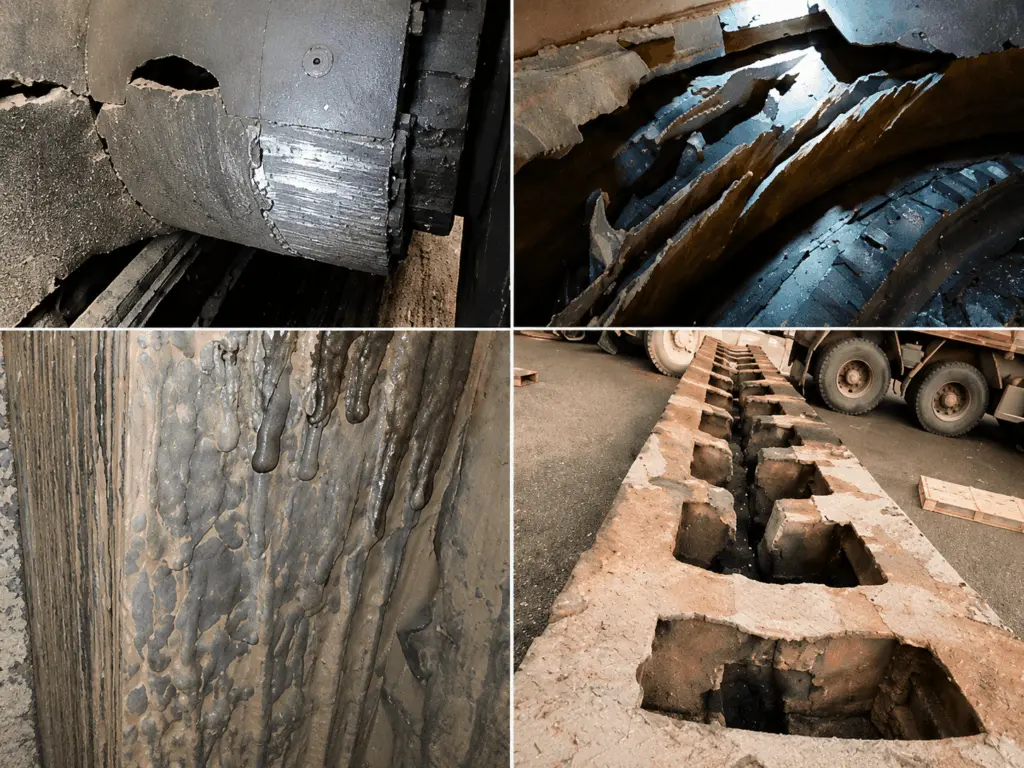
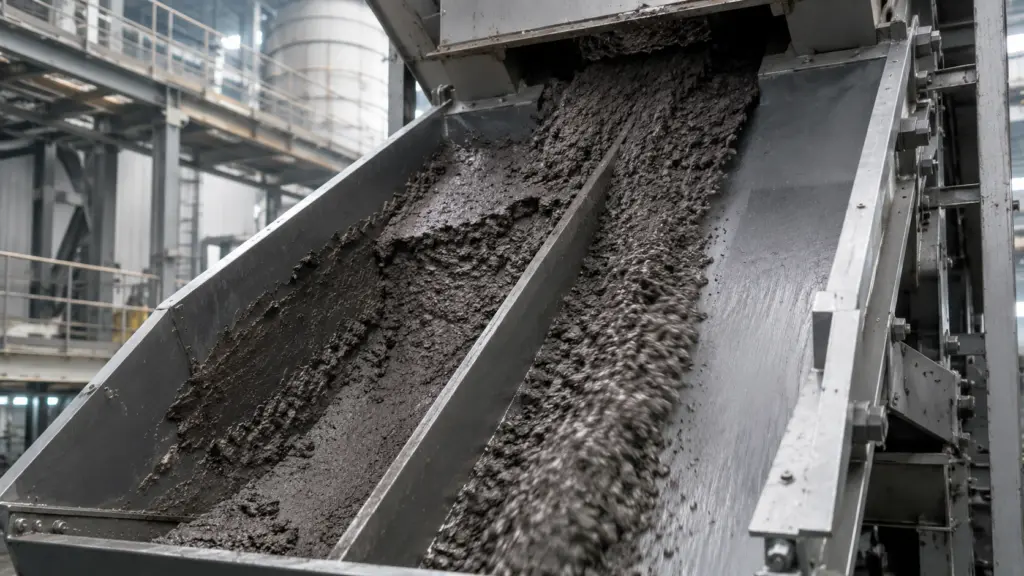
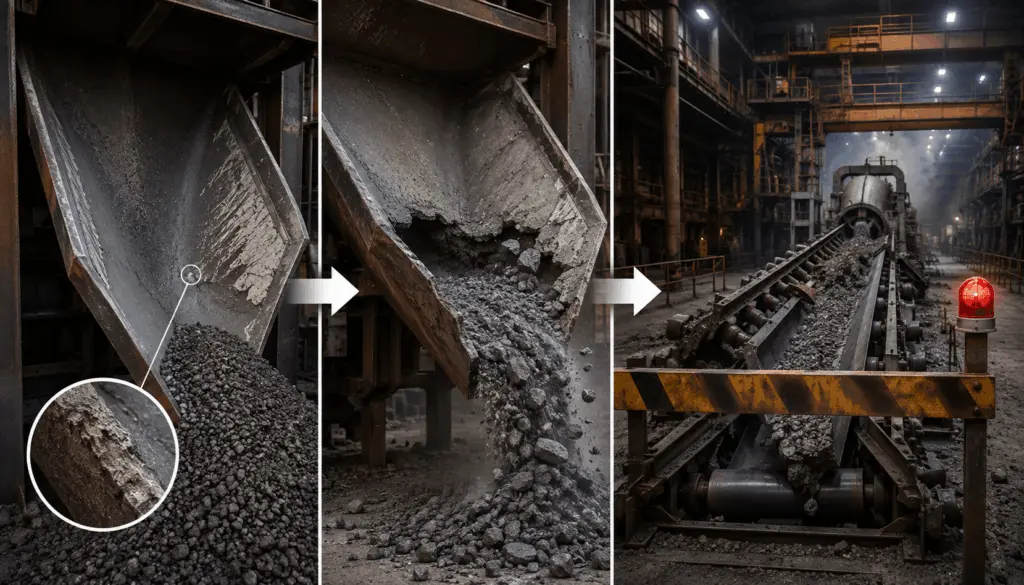
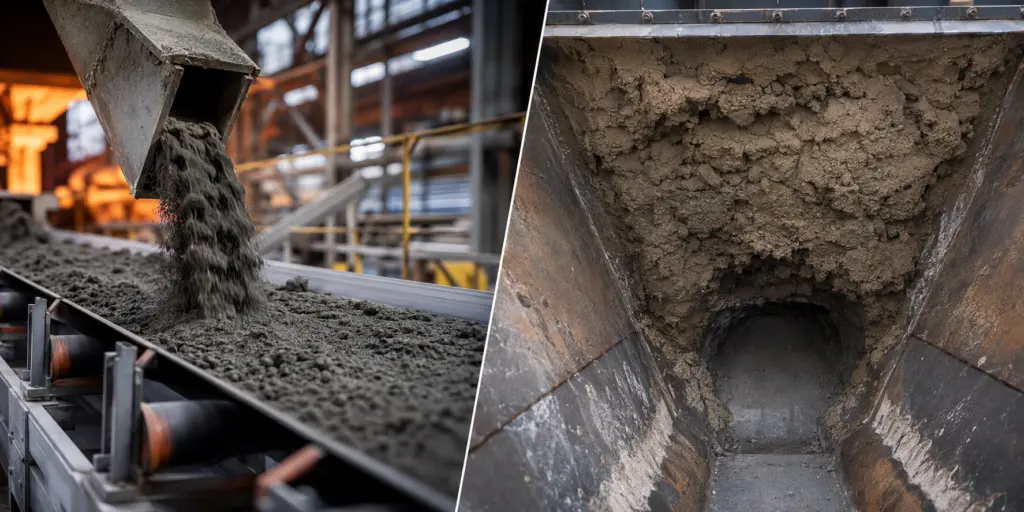
Flow blockage does not belong to the four types of wear because, in this case, the lining material is not gradually lost from the surface; instead, the handled material builds up and accumulates on the equipment walls. As the build-up layer increases, the flow cross-section narrows, the material flow slows down, and the conditions for further accumulation become increasingly favorable.
Therefore, a location can transition from slow-flow conditions to complete blockage within a short period. Before selecting a corrective approach, it is necessary to distinguish three common forms: wall build-up, arching, and ratholing, because each form is associated with different surface, geometry, and material-flow conditions.
1. Mechanisms of material sticking and flow blockage
1.1. Moisture creates conditions for material to adhere to the surface
Material can adhere to the surface under the action of two types of forces:
- surface adhesion forces between the material particles and the lining material
- liquid bridges, where water in the material forms a thin film and draws the particles toward the surface
A common condition requiring attention is the moisture content of the material. As the amount of water decreases, the effect of liquid bridges also decreases.
Therefore, in material-sticking problems, moisture content is one of the variables that needs to be checked before concluding that the cause lies in the hardness or wear resistance of the lining.
1.2. The build-up layer can create an increasingly rapid accumulation cycle
Blockage does not necessarily increase at a constant rate over time. Once a build-up layer has formed, it can itself make the flow conditions less favorable.
This cycle explains why a location can operate relatively steadily for a period and then transition more rapidly into a blocked condition.
Operating conditions do not necessarily need to change suddenly immediately before the blockage occurs. The build-up layer may have accumulated over multiple cycles until the remaining cross-section is no longer sufficient for the material flow to pass through.
1.3. Wall build-up, arching, and ratholing exhibit different characteristics
Not all flow-blockage phenomena involve the same mechanism.
These three forms should not be addressed in the same way.
Wall build-up is closely related to the interaction between the material and the surface. Arching and ratholing also require consideration of the wall angle, cross-section, and material-flow geometry.
Therefore, incorrectly identifying the type of blockage may lead to replacement of the lining without addressing the primary cause.
2. How to identify the cause in the field
2.1. Distinguishing adhesive wear from material sticking and flow blockage
Both terms involve “adhesion,” but they describe two different phenomena.
One indication that can be checked at the location is the thickness condition at the surface. If the thickness increases because an additional build-up layer has formed, the problem cannot be considered solely as wear loss of the lining.
This is the initial distinction to be made before proceeding to more detailed measurements.
2.2. The type of blockage needs to be identified from the material-flow condition
Three questions help narrow down the phenomenon:
- Does the material flow stop completely or only slow down?
- When the flow stops, does material remain above the discharge outlet?
- Is the accumulated material concentrated on the walls or only in a specific area?
If the flow stops while material remains above, the possibility of arching needs to be checked.
If the flow continues but mainly through the central region while the material adjacent to the walls remains stagnant, ratholing needs to be considered.
If material progressively builds up on the walls and the cross-section becomes increasingly smaller, wall build-up should be prioritized for investigation.
These questions help identify the governing form, but they do not mean that the three phenomena always occur completely independently.
2.3. The cause may lie in the surface, geometry, or material conditions
After identifying the type of blockage, the next step is to determine which group of factors needs to be checked.
The latter two groups are no longer purely material-related problems.
If the primary cause lies in geometry or the condition of the material, replacing the lining may change the timing of blockage occurrence but may not eliminate the cause.
2.4. Increasing hardness does not directly address the material-sticking mechanism
Hardness is relevant when the surface needs to resist hard particles cutting, scratching, or producing mechanical action.
In a material-sticking problem, the primary phenomenon is instead material being retained on the surface. Therefore, simply increasing hardness does not directly affect the mechanism by which the build-up layer forms.
The characteristics that need to be considered shift toward the ability to promote sliding flow and the interaction between the material and the surface.
The selection of material groups for this case is presented in the Principles of Material Selection knowledge cluster.
2.5. Changing flow conditions can help narrow down the cause
Before deciding to replace the lining, the response of the flow can be checked when geometric conditions or flow-assistance actions are changed.
If increasing the sliding angle restores the flow, the influence of geometry should be prioritized for consideration.
At locations where the angle cannot be changed directly, the response of the flow after light tapping or vibration can also provide additional information. If the flow is released after this action, the possibility of arching needs to be checked.
These checks only help narrow down the cause and do not replace measurement of the actual material-flow and geometric parameters.
3. Data that need to be recorded at a flow-blockage location
A flow-blockage survey needs to focus on the build-up layer and material-flow behavior, rather than only measuring the remaining lining material.
Four groups of information need to be recorded:
- build-up thickness and formation time
- build-up location, shown on a cross-sectional diagram
- material moisture content
- angle of the actual sliding surface
The angle to be measured is the angle of the working surface at the surveyed location; the value shown on the design drawing should not be used alone.
Once a build-up layer has formed, the geometry actually contacted by the material flow may also differ from the original condition of the equipment.
3.1. Blockage-clearing history needs to be converted into data
Comments such as “frequent blockage” or “requires frequent clearing” are not sufficient for comparison between different periods or for evaluating the impact on operations.
The information should be obtained from the operating log and recorded numerically.
Three data points that can be monitored include:
- the number of rodding or blockage-clearing interventions within a defined period
- the number of air-blasting interventions per shift
- the labor time spent on blockage clearing
Converting the intervention history into numerical data enables comparison of the condition before and after a change in the solution.
3.2. The survey season must be recorded together with the data
Moisture content and material condition may change with the season.
If conditions differ between the dry season and the rainy season, data from one point in time should not be used as representative of the entire year.
Therefore, the record needs to clearly state the survey timing, material conditions, and the season in which more severe blockage occurs according to operating data.
This information is particularly important when comparing different surveys or evaluating the effectiveness of a change at the location.
4. Three indicators need to be evaluated separately when assessing material sticking
To evaluate the material’s tendency to adhere and slide in greater detail, three indicators need to be considered:
- moisture
- stickiness
- sliding angle
These three indicators are presented in detail in Part 4: 3 indicators for evaluating material sticking: moisture, stickiness, and sliding angle.
5. Responsibilities of the departments
A flow-blockage survey requires coordination between the person observing the site, the operations department, and the person evaluating material-flow geometry.
Among these, evaluation of the angle and cross-section is particularly important in cases of arching and ratholing.
If material-flow geometry is not checked, the solution can easily default to material replacement even though the primary cause may lie in the equipment configuration.
6. Notes when applying this knowledge
First, this article focuses on the formation mechanisms and identification of blockage forms. The indicators used for detailed evaluation of material adhesion and sliding behavior are presented separately in Part 4.
Second, identifying arching or ratholing does not replace the material-flow design stage. When the cause is related to angle or cross-section, a separate engineering assessment is required before modifying the structure.
Third, wall build-up, arching, and ratholing may occur simultaneously at the same location. The purpose of classification is to identify the governing form so that the factor requiring priority investigation can be determined, not to assume that each location exhibits only one form.
Flow blockage needs to be evaluated as a material-flow problem, rather than automatically as a wear-protection problem. Distinguishing between wall build-up, arching, and ratholing helps determine whether the cause to be investigated lies in the surface, geometry, or material conditions before deciding to change the material.