Part 2: Influence of temperature on material operating limits
Temperature can directly alter the performance of a material. For heat-treated wear-resistant steel, when the temperature exceeds the appropriate range, the internal microstructure may continue to change in a direction that reduces hardness and mechanical properties. When the material cools down again, the properties that have been lost do not automatically recover to their original state.
The thermal problem also includes another factor that needs to be considered separately: thermal shock. A material group may perform well at a high temperature under steady-state conditions but still crack when the temperature changes rapidly and repeatedly.
Therefore, evaluating the thermal conditions at a location should not be limited to recording a single temperature value. It is necessary to determine simultaneously the operating temperature, peak temperature, and temperature-change cycles.
1. High temperature and thermal shock affect materials through two different mechanisms
The ability to withstand high temperature and the ability to withstand thermal shock are not the same property.
A material may perform well under one condition but be unsuitable for the other.
Distinguishing between these two conditions from the outset helps avoid looking only at a general “heat resistance” parameter and assuming that the material is suitable for all thermal conditions.
1.1. Heat-treated steel may lose mechanical properties when its temperature limit is exceeded
The mechanical properties of heat-treated wear-resistant steel are developed through a quenching and tempering process at the mill.
This process creates an internal microstructure that enables the material to achieve the required hardness and performance properties. However, this microstructure remains stable only within a certain temperature range.
When the material continues to operate at a temperature above the appropriate limit, the internal microstructure may continue to change in a direction that softens the material. This can be understood as a process of unintended further tempering during operation.
Therefore, operating temperature not only affects the material’s instantaneous condition but may also alter its ability to retain mechanical properties over time.
1.2. Degraded mechanical properties do not automatically recover when the material cools
Once the internal microstructure of the steel has changed as a result of exceeding the temperature limit, cooling the material does not automatically restore the microstructure to its original state.
This differs from a situation in which the material merely heats up and then cools down without undergoing a microstructural change.
Therefore, it should not be assumed that, after cooling, the material will automatically regain all of the hardness or mechanical properties lost as a result of operating at excessive temperature.
1.3. Thermal shock causes damage when temperature changes too rapidly
Thermal shock occurs when the temperature of a material changes rapidly, causing non-uniform thermal expansion between different regions.
The surface may heat up and expand first while the interior has not yet had sufficient time to undergo a corresponding change. This difference generates stress within the material.
For brittle material groups, thermal stress may lead to cracking even when no significant external mechanical load is applied.
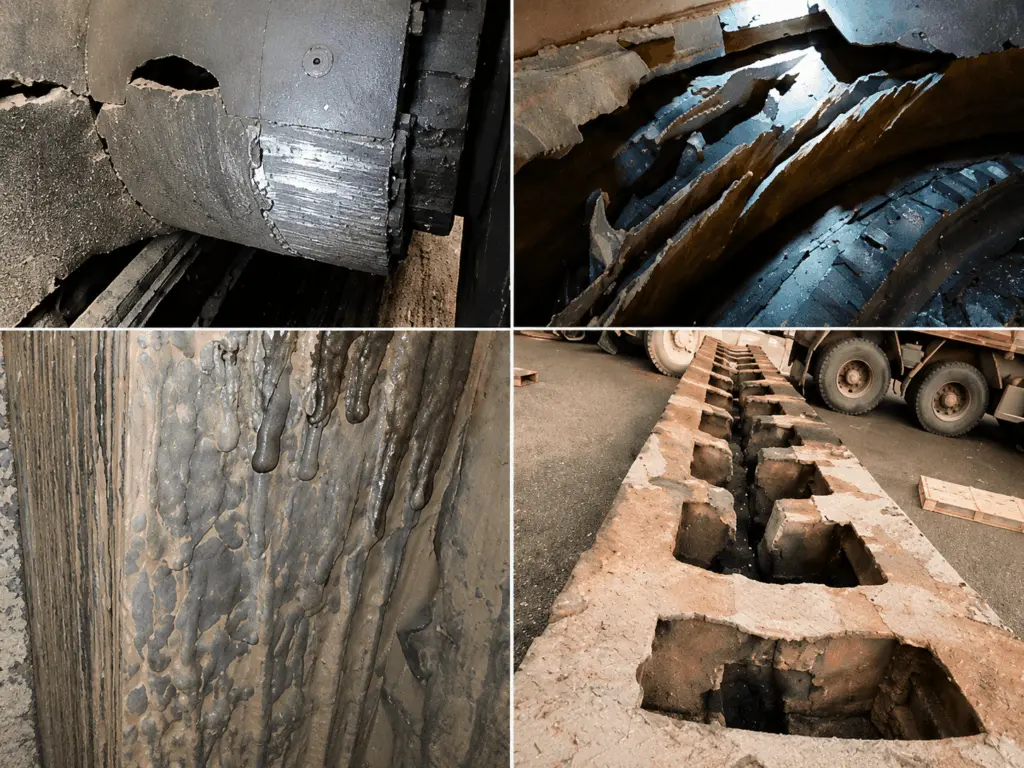
One sign requiring attention is network cracking on the surface, which differs from the gradual loss of material thickness caused by wear.
A material may operate stably at a very high temperature but still be unsuitable for a location that frequently undergoes rapid heating–cooling cycles.
2. Field temperature assessment needs to include both operating temperature and peak temperature
A temperature value measured at the time of the survey is not sufficient to represent the full operating conditions of the location.
At a minimum, the following need to be distinguished:
Operating temperature is the temperature at the location when the production line is operating under steady-state conditions.
Peak temperature is the highest temperature to which the location may be exposed during operation.
Peak temperature may occur at times that do not coincide with the survey, for example:
- during equipment or production-line start-up
- when an overload occurs
- when the material flow or material conditions change
Therefore, measuring temperature only under steady-state operating conditions may overlook the very thermal condition that determines the material’s operating limit.
3. Data requiring attention when evaluating temperature
The measurement result depends not only on the instrument but also on the location, surface condition, and time of measurement.
Among these factors, material build-up is easily overlooked. If temperature is measured on the build-up layer rather than on the surface being evaluated, the data may lead to an incorrect assessment of the material’s operating conditions.
Therefore, the report should record together with the measurement the measurement location, surface condition, and time of measurement.
4. Each temperature-measurement instrument has a different range of application
Two methods that can be used in the field are non-contact infrared measurement and direct contact measurement on the surface.
Emissivity is a surface property that affects the reading of an infrared instrument. Clean metal surfaces, oxidized surfaces, and surfaces covered by material build-up may produce different results.
Therefore, an infrared thermometer is suitable for scanning and identifying high-temperature areas, while contact measurement can be used to supplement the data at accessible locations.
A single measurement method should not be assumed to be suitable for every location.
5. Thermal-shock assessment needs to include temperature range, duration of change, and number of cycles
Knowing only the maximum temperature is not sufficient to determine thermal-shock conditions.
Three items of information need to be recorded:
- the lowest and highest temperatures within one cycle
- the duration of the temperature change between the two levels
- the number of temperature-change cycles per day or per week
The number of cycles should be obtained from operating data rather than based solely on estimates made at the time of the survey.
The point that needs to remain clear is that thermal shock depends on the magnitude of the temperature change combined with the rate of change and the frequency of repetition.
A location with a high peak temperature but a gradual temperature increase is not under the same condition as a location that repeatedly and rapidly switches between two widely separated temperature levels.
Therefore, these three data points need to be considered together before evaluating the effects of thermal shock.
6. Thermal expansion needs to be considered from the installation stage
As temperature increases, materials expand. This expansion needs to be taken into account in the design and installation of the lining.
A clearance that is too small may not provide sufficient allowance for material expansion as the temperature rises. Conversely, a clearance that is too large may allow material to enter or become wedged in the fastening area.
Both requirements need to be calculated according to the actual conditions and should not be determined solely on the basis of experience or field estimates.
This article focuses on the effects of temperature on material performance. Clearance calculation and thermal-expansion accommodation fall within the scope of design, fabrication, and installation.
7. Temperature needs to be evaluated at each individual location
Two locations within the same process stage do not necessarily operate at the same temperature.
Material flow may change direction, velocity, or condition before passing through each item of equipment. The distance from the heat source and the heat-transfer conditions at the surface may also differ.
Therefore, the temperature measured at one point should not be used as representative of an entire process stage or production line.
Each location needs its own temperature data when those data are used to evaluate material performance.
This principle is particularly important when two locations are separated by only a short distance but one is exposed to high temperature while the other is simultaneously subjected to high-velocity particle flow or significant temperature fluctuations.
8. Thermal degradation may only become evident after a period of operation
Thermal damage does not always appear immediately as a clearly visible indication.
The material may continue operating with degraded mechanical properties before the deterioration rate increases sufficiently to become noticeable through maintenance activities.
One indication that needs to be considered is a wear rate that gradually increases over time while the main material-flow conditions do not change significantly.
When this situation occurs, temperature is one of the factors that needs to be rechecked, particularly the history of peak temperatures and periods during which the equipment operated outside steady-state conditions.
This indication alone is not sufficient to conclude that temperature is the cause. It only provides a basis for extending the investigation to the thermal conditions at the location.
9. Responsibilities of the departments
Thermal data often cannot be obtained in full from a single survey. Part of the information needs to be measured directly, while the remainder depends on the operating history of the equipment.
Among these, peak temperature during start-up or abnormal operating conditions is often the most difficult data to obtain directly. The survey engineer is not always present at those specific times.
Therefore, data from the operations department need to have their source clearly recorded and be presented alongside field measurements, rather than treating the two types of information as the same.
10. Notes when applying this knowledge
Three points need to remain clear.
First, the specific temperature limit depends on the individual material grade. General limits by material group serve only as an initial guide. When evaluating a specific material, the technical documentation for that particular grade needs to be consulted.
Second, the explanation of the degradation of mechanical properties in heat-treated steel in this article is intended only to clarify the principle of how temperature affects material performance. The content does not replace specialized documentation on heat treatment.
Third, thermal shock does not have a single common threshold that can be applied to every material. The evaluation needs to consider the temperature range, duration of the temperature change, and number of cycles together under the same operating conditions.
Temperature data are only meaningful when recorded at the correct location and under the correct operating condition. Operating temperature indicates the normal condition, peak temperature indicates the limit to which the material may be exposed, while temperature-change cycles provide additional information for identifying thermal-shock risk. These three data groups need to be clearly separated before material performance is evaluated.