Part 9: Selecting the appropriate approach for actual situations
Unlike the previous eight technical articles, Part 9 does not introduce a new technical procedure.
Instead, this article helps identify the appropriate starting point when a practical problem arises.
A batch of material that has never been fabricated before, a lining that repeatedly detaches, and an upcoming planned shutdown present three different challenges. Starting with the wrong issue can waste time addressing something that is not the primary cause.
1. Three situations require three different starting points
These situations require different approaches because the initial risks are different.
For a new material batch, the main risk is applying incorrect fabrication parameters.
For repeated lining detachment, the risk is mistaking an attachment failure for a material failure.
For downtime planning, the risk is preparing a schedule without accounting for waiting periods that cannot be shortened.
1.1. When preparing to fabricate a material grade that has not been processed before
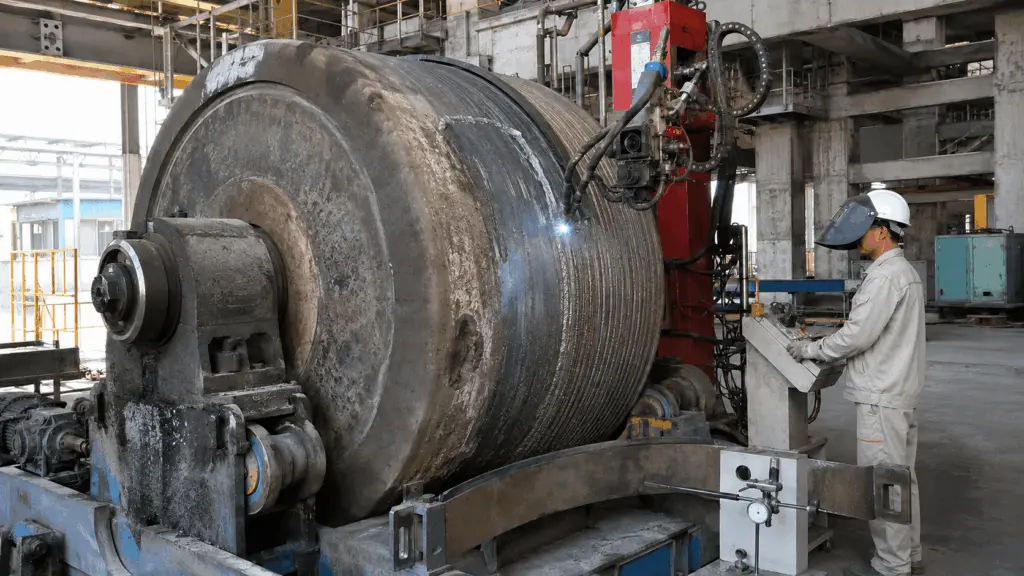
The starting point is to consult the technical documentation for the exact material grade and thickness range.
Parameters used in subsequent operations depend directly on this information.
Welder qualification records are easily treated as administrative documentation. However, they form part of the quality requirements that must be verified before welding begins.
A newly completed weld may not show immediate signs of a problem. Controlling the initial conditions is therefore more valuable than waiting until damage occurs before investigating its cause.
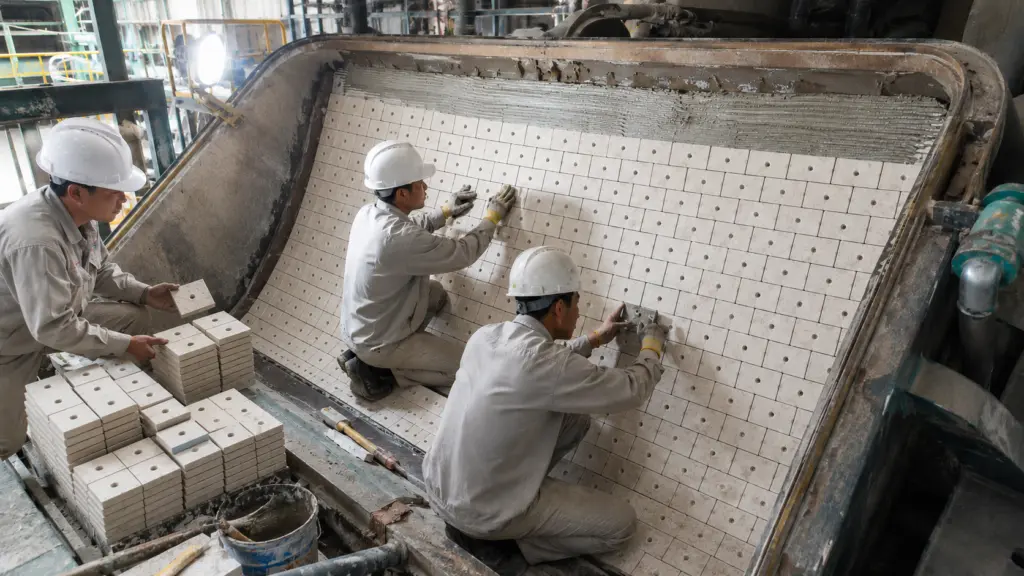
1.2. When a lining repeatedly detaches at the same location
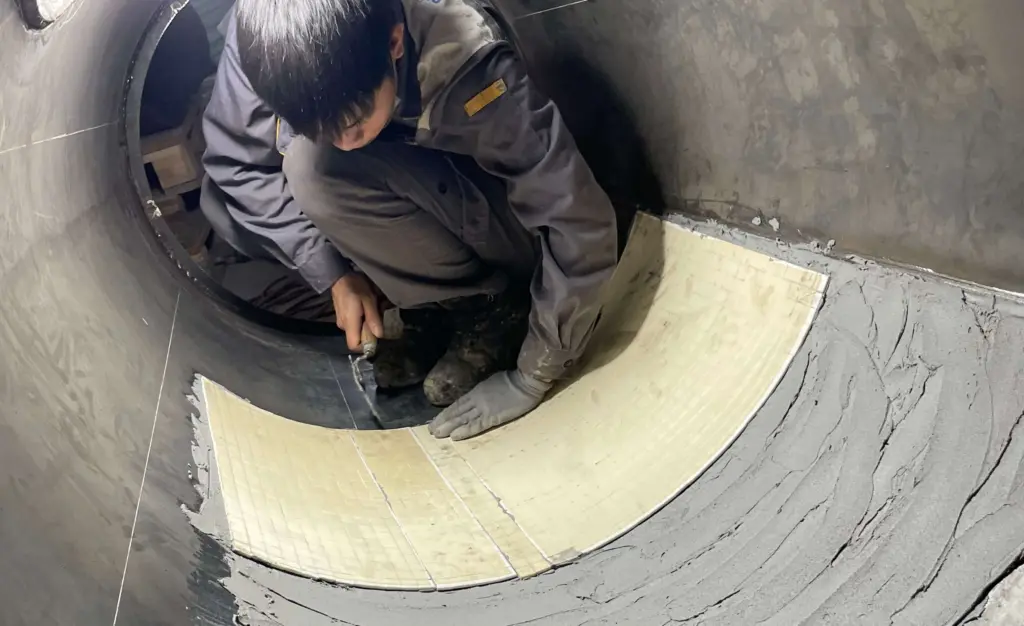
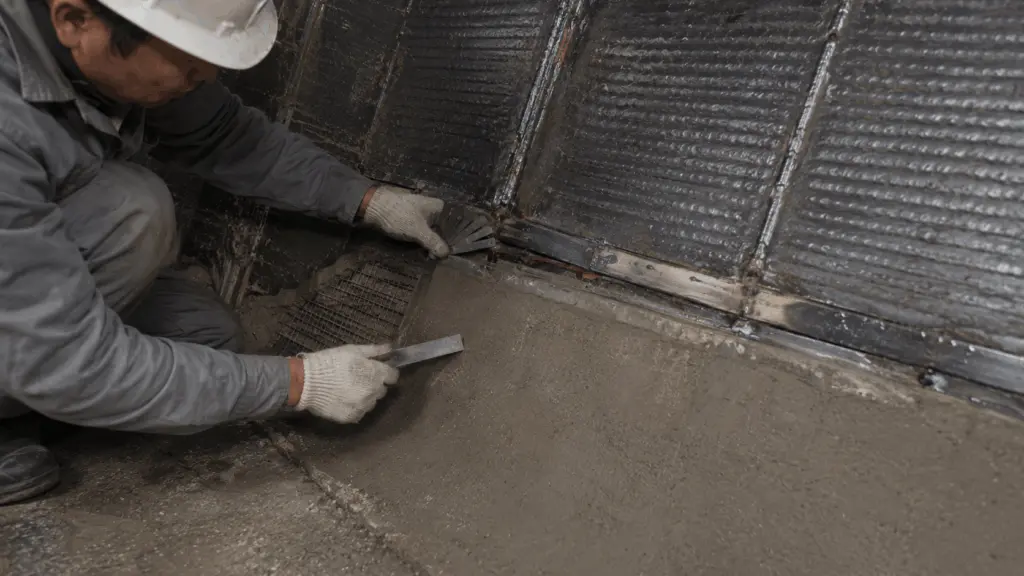
If a non-metallic lining repeatedly detaches, it should not automatically be assumed that a different material is required.
The first step is to distinguish between two possibilities:
Has the lining material itself failed, or has the fixing mechanism failed?
For adhesive-bonded systems, tile corners require particular attention.
At these locations, the adhesive joint experiences peel stress, which is less favorable than the shear stress acting across the central area. Even a small adhesive void at a corner may become the starting point for detachment.
Inspection methods for each fixing mechanism are discussed in Part 3: Fixing non-metallic linings: field installation techniques.
1.3. When planning work during downtime
For a planned shutdown, the challenge is not limited to the number of tasks that need to be completed.
It is also necessary to determine:
- Which activities must be performed sequentially
- Which activities can be performed in parallel
- Which stages require mandatory waiting periods
The basic sequence is as follows:
Mandatory material waiting periods cannot be shortened simply by increasing manpower.
If the available downtime is reduced, the principle is to reduce the work scope rather than shorten mandatory material waiting periods.
Detailed scheduling methods are discussed in Part 7: Joint design and installation during downtime.
2. How to select the appropriate article for your responsibilities
You do not necessarily need to read the entire knowledge series in the same order.
If you are new to working with these materials, reading specification tables alone is often insufficient.
Technical documentation identifies the limits and requirements that must be followed. The articles in this series explain which operations those requirements affect and where deviations may occur.
3. Three actions that can be taken immediately in the workshop
A dedicated process review is not always necessary. Several checks can be performed immediately using existing resources.
3.1. Display warnings at the relevant workstations
Operations that should be avoided need to be clearly displayed where personnel can see them before starting work:
- Do not reheat materials without technical authorization.
- Do not rebend components to correct an angle.
- Do not bend across an embossed marking.
- Do not stack plates in a way that creates three-point bending.
- Do not return leftover plates to storage while sharp cut corners remain.
The objective is to communicate these warnings before incorrect operations occur, rather than using the list only after damage has been identified.
3.2. Perform a quick inspection of an installed lining
These checks can help identify certain attachment problems before the equipment returns to operation.
Detailed inspection methods are provided in Part 3: Fixing non-metallic linings: field installation techniques.
3.3. Perform a quick inspection of materials in storage
Three points can be checked immediately:
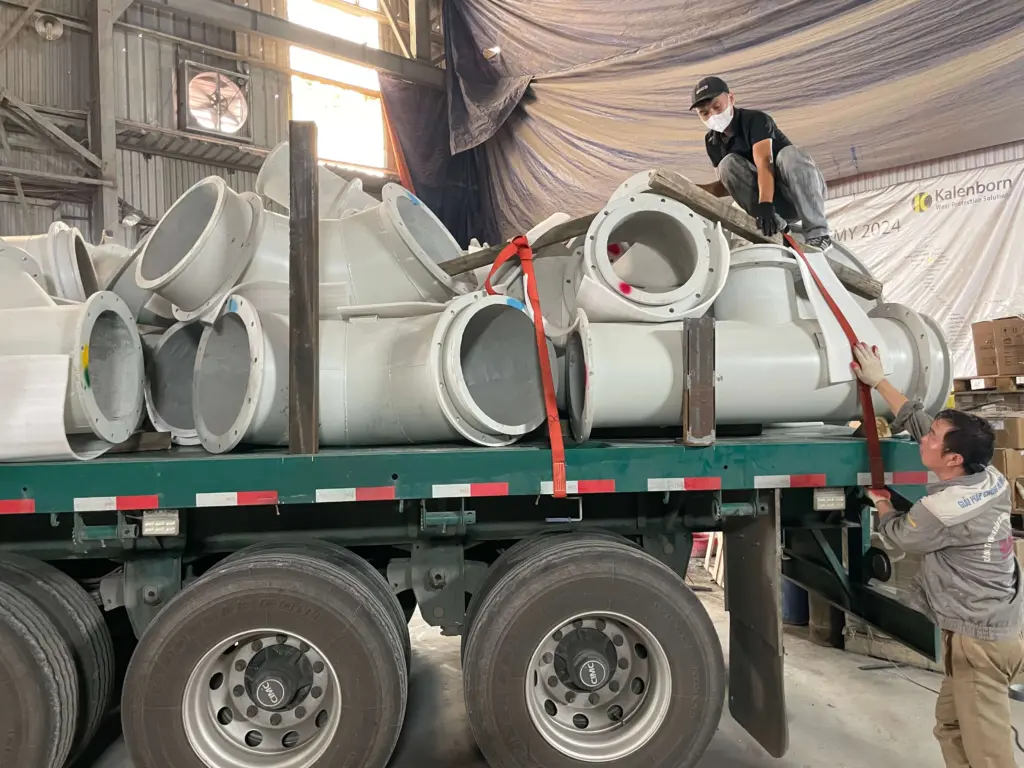
- View plates from the side to determine whether they deflect between support points.
- Check whether timber spacers between plate layers are vertically aligned.
- Confirm that sharp cut corners have been treated before leftover plates are returned to storage.
For very high-hardness grades, these conditions may be associated with delayed-cracking risk, as discussed in Part 6: Handling, storage and preservation.
4. Situations that warrant a process review
The objective of a process review is not necessarily to replace materials or introduce additional equipment.
Its primary value lies in comparing current workshop practices against the applicable technical requirements.
Four situations particularly warrant a process review:
- A component uses two material groups at the same interface.
- Cracking appears along the edge of a weld.
- A lining repeatedly detaches at the same location.
- Available downtime is insufficient to accommodate the mandatory waiting periods of the selected material.
If cracking appears along a weld edge, thermal conditions, the welding procedure and related records should be reviewed before determining the cause.
5. Situations that can be addressed using existing data
Not every situation requires a separate process review.
The important distinction is between missing fabrication data and a problem outside the scope of fabrication.
If material build-up results from equipment geometry, flow direction or operating conditions, repeatedly changing installation methods without reassessing the root cause will not address the underlying problem.
6. Scope of application and references
This article helps identify the appropriate starting point and directs readers to the relevant technical articles. It does not replace the specific technical requirements discussed in each part.
Three points should be noted when using this article.
First, parameters specific to material grades, thicknesses, materials or procedures must still be checked against current technical documentation. Part 9 does not reproduce these parameters.
Second, the recommended reading sequence for each role is intended as guidance. In practice, one person may be responsible for several activities, so the order in which the articles are consulted may vary.
Third, the situations that can be addressed using existing data do not form an exhaustive list. When actual conditions change or available data are insufficient, the relevant technical article should be revisited for further evaluation.
The situation-based approach, role-specific reading guidance and criteria for identifying when a process review is needed are based on Gia Anh’s work organization methodology.