Part 4: Zoning High-Strength Steel and wear-resistant steel on truck bodies
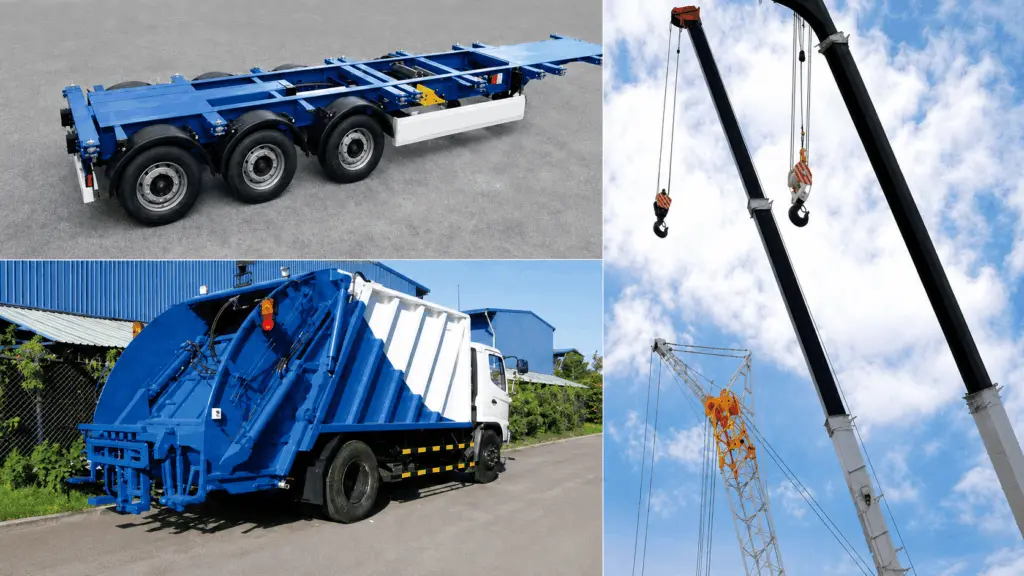
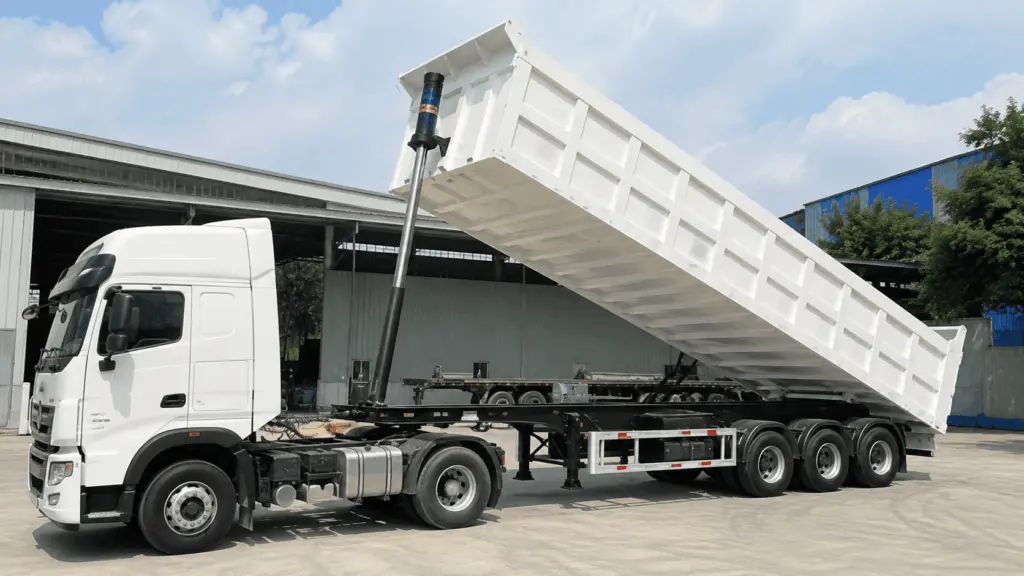
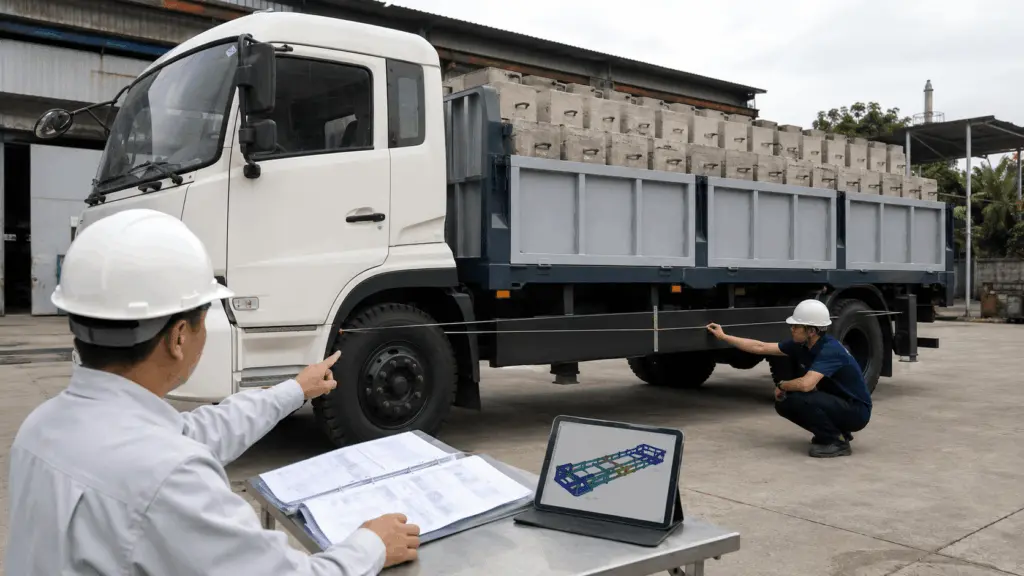
Different areas of the same truck body do not operate under the same conditions.
The floor, dump body floor or lower side walls may be exposed to friction, abrasion and direct impact from cargo. By contrast, beams, frames and other load-bearing components primarily operate under structural and dynamic loading.
Material selection should therefore not begin by asking which steel has higher hardness or yield strength. It should begin with the function of each area within the structure.
Two commonly used material groups are wear-resistant steel and High-Strength Steel. Both can provide high mechanical properties, but they are developed for different operating requirements. Correct material zoning from the design stage helps prevent materials from being used for the wrong function while providing a basis for reducing weight without losing control of service life or load-carrying capability.
1. Two steel groups, two different roles
The key difference lies in the design purpose of the material.
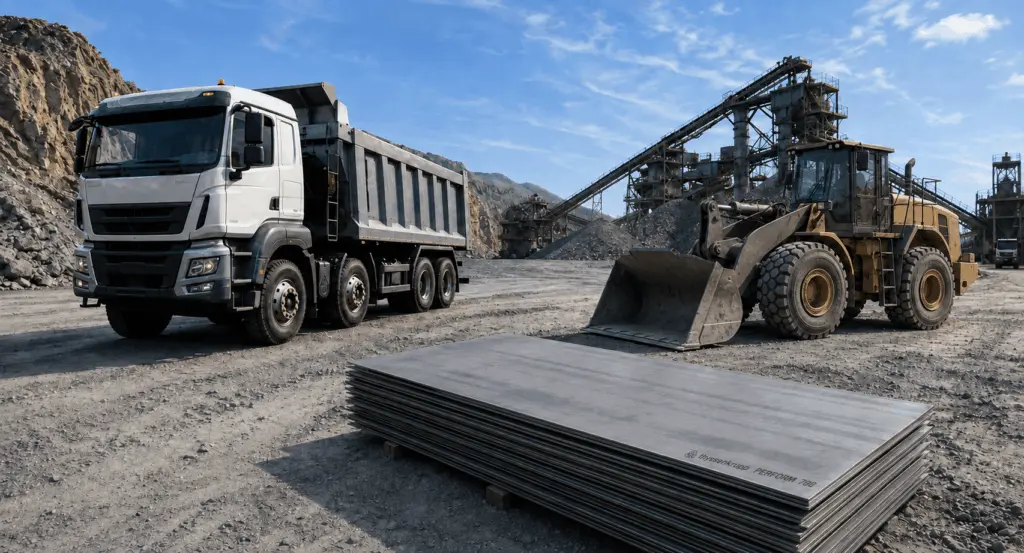
Wear-resistant steel is selected primarily to protect surfaces against the effects of bulk material, rock, slag, scrap and other highly abrasive cargo.
High-Strength Steel used in structural applications needs to meet requirements relating to:
- load-carrying capacity
- toughness
- formability
- weldability
- dynamic loading
- declared mechanical properties for structural applications
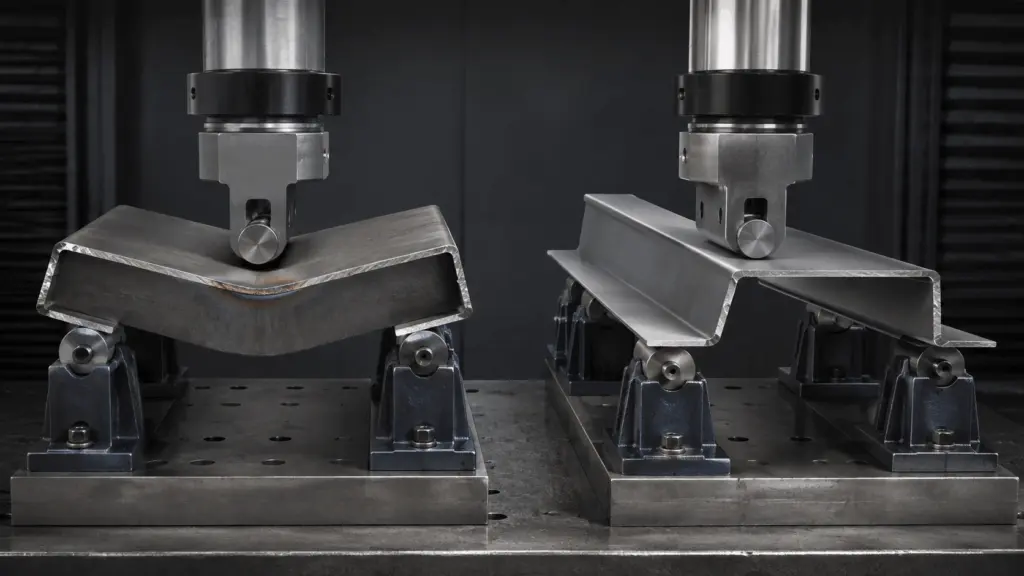
High hardness alone therefore does not demonstrate that a steel plate is suitable for use as a load-bearing beam or frame.
Similarly, high yield strength alone does not demonstrate that a material is suitable for an area exposed directly to wear.
2. Do not automatically use wear-resistant steel for load-bearing structures
A wear-resistant steel plate may also have very high hardness and mechanical properties. However, this does not mean that it is designed to replace High-Strength Steel in every load-bearing position.
Beams, frames and dynamically loaded components need to be evaluated against the requirements of the structure itself, including:
- yield strength
- tensile strength
- toughness
- formability
- weldability
- thickness
- delivery condition
- application scope declared by the manufacturer
If the product documentation does not confirm the material for the specific structural application, it should not be used as a substitute based only on hardness or a limited number of mechanical properties.
The key point is to avoid treating “very hard material” as equivalent to “material suitable for load-bearing structures”.
3. Material zoning starts from the operating conditions of each area
Each area of a truck body needs to be considered according to the main effects acting on it.
This table provides only an initial basis for material zoning.
It should not be used as a fixed material layout for every truck body because the actual boundary depends strongly on the type of cargo being transported.
4. Cargo type determines how extensive the wear zone needs to be
For the same truck body design, the area requiring wear-resistant steel may vary significantly depending on the cargo.
For example, with rock or sharp-edged scrap, the lower side wall may experience severe impact during loading and unloading.
With bagged cargo, however, the side walls may not be exposed to the same wear mechanism.
The material boundary should therefore not be defined simply by a fixed height on the side wall.
The following need to be considered:
- cargo type
- bulk density
- particle size
- sharpness
- loading method
- unloading method
- areas receiving the greatest material-flow impact
5. The boundary between the two material groups needs to be shown on the drawing
If a truck body uses both wear-resistant steel and High-Strength Steel, the boundary between the two groups needs to be defined during the design stage.
This division should not exist only in the designer’s experience or be decided directly in the workshop.
The drawing should show:
- start and end positions of the wear-exposed zone
- material group used in each area
- thickness
- required material grade or strength grade
- transition zones
- connection details between the two material groups
This is particularly important when the documentation passes through several functions:
Design → Procurement → Fabrication workshop → Quality inspection
If the boundary is not clearly shown, different functions may interpret the same drawing differently.
6. Transition zones need to be treated separately
Where wear-resistant steel meets High-Strength Steel, a transition zone is created.
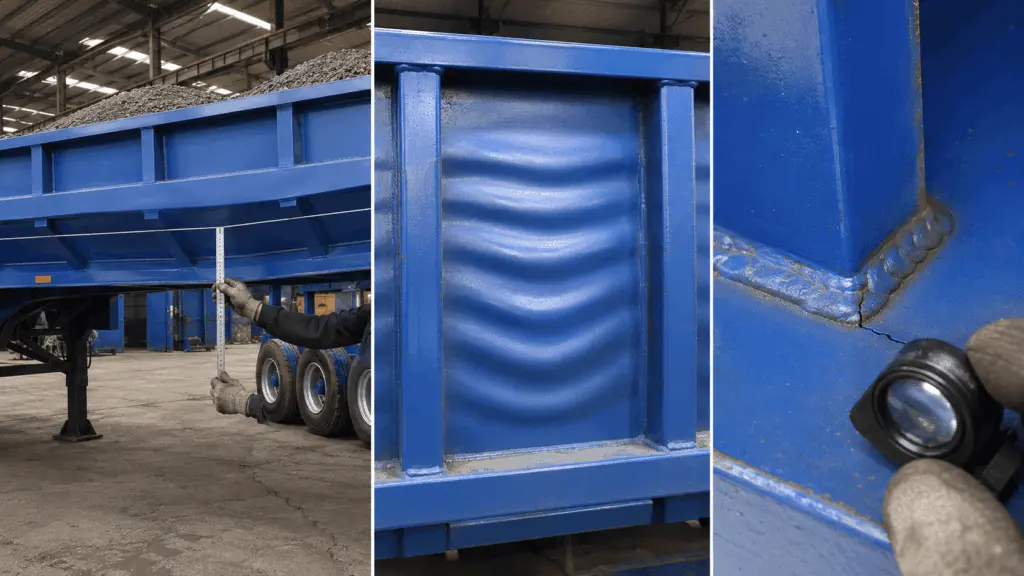
This is not simply a material boundary shown on the drawing. It may contain a welded connection between two steel groups with different fabrication requirements.
The following factors need to be defined:
A welding procedure for one steel group should not automatically be applied to the other.
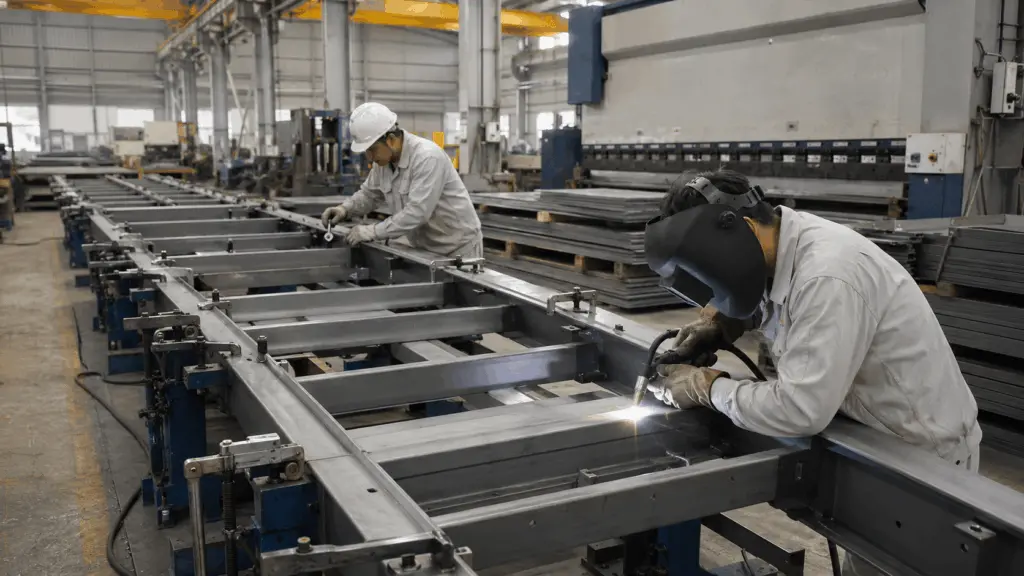
Similarly, welders should not be expected to determine how the transition zone is handled based only on experience or the welding consumables currently available.
The transition zone needs to be resolved through design and the welding procedure before the documentation reaches the workshop.
7. Two-component wear-resistant plate should not automatically be treated as a load-bearing structure
A specific case that needs to be considered separately is two-component wear-resistant plate.
These plates typically consist of:
- a wear-resistant layer
- a steel backing layer used to support the lining and facilitate installation
The backing steel may look similar to a conventional structural steel plate, but it should not automatically be assumed to be guaranteed for load-bearing applications.
If the manufacturer declares the backing layer only for use as the substrate of the wear-resistant plate, using it as a beam, frame or other load-bearing component needs to be evaluated separately.
The principle is:
The application scope of a material needs to be based on the technical declaration for the product itself, not inferred from appearance or from the backing material alone.
8. Four groups of information to review when selecting steel for load-bearing structures
When selecting High-Strength Steel for structural areas, yield strength should not be the only property reviewed.
At least four groups of information need to be considered.
In particular, impact toughness values need to be read together with the test temperature.
An impact energy value without the corresponding test temperature does not provide a sufficient basis for comparison.
Similarly, elongation values should only be compared when they are based on the same test conditions.
9. Increasing the steel grade changes more than yield strength
Within the perform® High-Strength Steel range, declared elongation tends to decrease as the yield strength grade increases.
These values apply to the thyssenkrupp perform® product range, with tensile testing according to EN ISO 6892-1 and impact testing according to EN ISO 148-1.
The table shows that increasing the steel grade does more than increase yield strength.
As elongation decreases, formability also needs to be checked more carefully.
Steel grade selection therefore needs to be considered together with:
- bending
- forming
- thickness
- cross-sectional design
- workshop fabrication conditions
10. Do not compare elongation values based on different measurement bases
Elongation may be declared using different gauge lengths.
Two common forms are:
- fixed gauge length
- gauge length proportional to the specimen cross-section
The same material may produce different values depending on how elongation is determined.
When:
- comparing two steel grades
- defining technical requirements
- including values in a contract
- performing material acceptance inspection
the measurement basis for the elongation value needs to be checked.
Values determined using different bases should not be placed side by side and used directly to conclude that one material has greater deformation capability than another.
11. Note on perform® 650 and 700 at thicknesses above 8 mm
For the perform® 650 and 700 grades referenced in this article, the minimum yield strength changes with thickness.
For plate thicknesses above 8 mm:
- grade 650 has a minimum yield strength of 630 MPa
- grade 700 has a minimum yield strength of 680 MPa
This shows that the grade designation is not always the value that can be used directly for every thickness.
When mechanical properties are used in calculations, the following need to be checked:
- correct material grade
- correct thickness
- correct guaranteed value
- correct version of the technical documentation
12. The two steel groups cannot be distinguished by appearance
Wear-resistant steel and High-Strength Steel can look very similar.
Material identification should not be based on:
- surface color
- surface finish
- sound when tapping the plate
- visual appearance of the plate
Identification needs to be based on:
- plate identification number
- material marking
- accompanying documentation
- traceability to the production batch
Some properties can be checked in the workshop, but not all of them.
A measured hardness value also does not replace documentation for determining the full material properties or its intended application scope.
13. Three points that need to be finalized before completing the material solution
Before the drawing is released for fabrication, three areas need to be clarified.
First. Function of each area
It needs to be established whether the area is exposed to:
- wear
- impact
- structural loading
- dynamic loading
- or a combination of several effects
Second. Boundary between material groups
The boundary needs to be shown directly on the drawing, together with:
- material group
- thickness
- technical requirements
- transition zone
Third. Connection treatment at the transition zone
The following need to be defined in advance:
- joint configuration
- welding consumables
- thermal conditions
- applicable procedure
- function responsible for approval
If the transition zone has not been resolved, the material solution is still incomplete even if each individual steel plate has been selected correctly.
14. Responsibilities of the different functions
The workshop should not independently change the material group or connection method at a transition zone without technical approval.
15. Notes on applying this knowledge
First, the boundary between wear-exposed and load-bearing zones changes according to cargo type, loading and unloading methods, and truck body design. A fixed zoning layout should not be applied to every vehicle.
Second, wear-resistant steel may have very high mechanical properties, but it should not automatically replace High-Strength Steel in load-bearing positions unless the application scope, structural calculations and fabrication requirements have been confirmed.
Third, for two-component wear-resistant plate, the steel backing layer should not automatically be treated as a structural material. The declared application scope of the product needs to be checked before use.
Fourth, elongation and toughness values are only meaningfully comparable when the test conditions and measurement basis are compatible. When used in technical documentation, the applicable standard and test conditions need to be stated clearly.
Fifth, the transition zone between the two material groups needs to be treated as a separate technical detail. The materials should not simply be joined and a familiar welding procedure applied without further evaluation.
Sixth, material identification needs to be based on identification numbers and documentation. Surface appearance or an isolated hardness measurement is not sufficient to establish the full material characteristics.
Correct material zoning allows each steel group to perform the function for which it was selected. Wear-resistant steel protects surfaces directly exposed to wear, while High-Strength Steel serves the structural areas that carry loads and dynamic loading.
The value of the solution does not come from using one steel type throughout the entire truck body. It comes from defining the boundaries between material groups correctly and resolving the transition zones from the design stage.