Part 2: Principles of reducing structural thickness with High-Strength Steel
Reducing thickness is not simply a matter of replacing a thick steel plate with a thinner one.
To reduce mass while maintaining the required load-carrying performance, it is necessary to understand the stress level at which the material begins to undergo permanent deformation, how much deformation capacity remains, and whether the required cross-sectional geometry can actually be fabricated.
Three properties are commonly considered together: yield strength, tensile strength and elongation. Each represents a different material characteristic.
In structural weight reduction, yield strength is an important basis for evaluating load-carrying capability, while elongation and bending radius largely determine whether the material can be fabricated into the required geometry.
1. How do yield strength, tensile strength and elongation differ?
These three properties are not interchangeable.
A steel grade with high tensile strength does not mean that the structure can operate up to that stress level. Before reaching tensile strength, the material may already have exceeded its yield strength and undergone permanent deformation.
For truck body structures, this distinction is important.
A steel plate may not yet have cracked or fractured, but if the floor, side wall or beam has already undergone permanent deformation, the structure is no longer operating in its original design geometry.
When evaluating thickness reduction, yield strength therefore needs to be considered before tensile strength.
2. Elongation indicates the remaining deformation capacity of the material
Elongation often receives less attention than yield strength because it does not directly indicate how much load a structure can carry.
However, for steel that needs to be bent or formed, it is an important property that should not be overlooked.
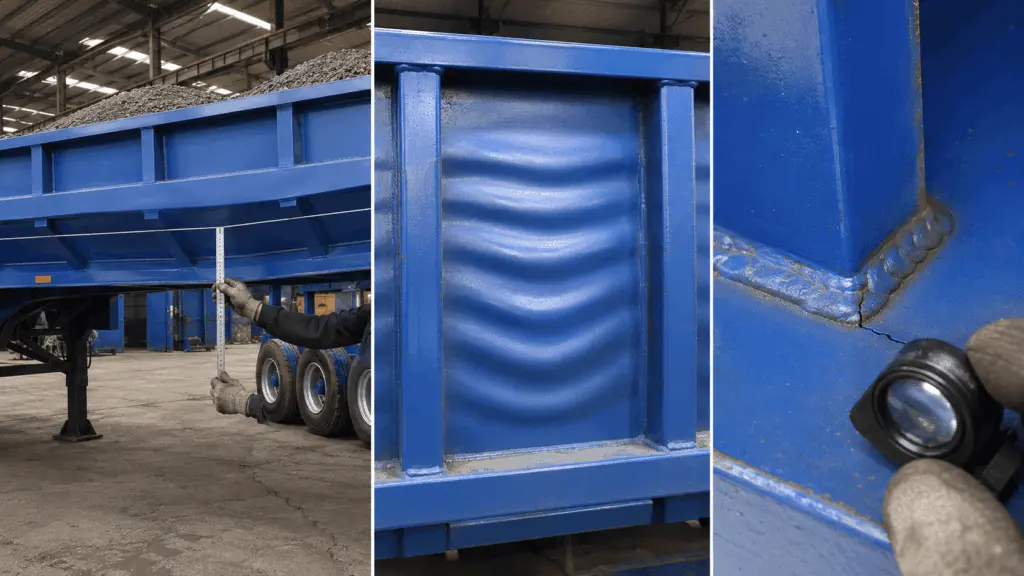
One case recorded in Gia Anh’s survey documentation involved a steel plate that had been bent three times without fully breaking. Based only on visual observation, the material might still appear usable.
However, the fact that the material has not fractured does not mean that it remains in its original condition. The deformation process has already consumed part of the material’s deformation capacity.
This is why steel usability should not be assessed simply by repeatedly bending the material and observing whether it breaks.
This becomes particularly important as the steel grade increases, because the declared deformation capacity tends to decrease.
3. As yield strength increases, elongation tends to decrease
For perform® High-Strength Steel, elongation changes with yield strength grade.
The values in this table are taken from thyssenkrupp perform® steel product documentation, with tensile testing according to EN ISO 6892-1.
The table shows that as the yield strength grade increases, the declared elongation tends to decrease.
This directly affects how a higher steel grade should be evaluated.
A higher grade does not only provide greater yield strength. It may also impose more restrictive forming requirements.
A steel grade should therefore not be selected only because a thinner plate is desired. Bendability, the required bending radius and the available workshop equipment need to be considered from the design stage.
When reading elongation data, one additional point needs attention.
Elongation may be declared using different measurement bases.
Values may be determined using:
- a fixed gauge length
- a gauge length proportional to the specimen cross-section
Values determined using different measurement bases should not be placed side by side and used directly to conclude that one material has greater elongation than another.
When elongation data is included in technical documentation, the test method and measurement basis need to be stated clearly.
4. Select the standard group according to how the structure will be fabricated
Before selecting the yield strength grade, the main fabrication method for the component needs to be determined.
Two standard groups are used for different material scopes.
The important question is not which standard is “higher”, but whether the material is suitable for the way the component will actually be fabricated.
If a structure requires multiple formed ribs, deep bends or narrow sections, formability needs to be considered from the material-selection stage.
Conversely, if the component will mainly be cut and welded, greater attention needs to be given to the material condition, welding requirements and the heat-affected zone.
The sequence should therefore be:
Define the structure → Define the fabrication method → Select the standard group → Select the yield strength grade → Select the specific steel grade.
5. Select the steel grade level first, then the specific material grade
A common mistake is to start with a steel grade that is already available and then try to adapt the design around that material.
This can allow material availability to determine the structural solution unintentionally.
Instead, the process should be divided into two decisions.
Technical decision
The design team determines:
- load requirements
- required yield strength grade
- thickness to be considered
- elongation
- bendability
- fabrication conditions
Commercial decision
Once the technical grade requirements have been defined, procurement selects a specific material grade within the approved technical range.
This separation ensures that the material grade is selected to support the design, rather than modifying the design simply because a particular grade is readily available on the market.
6. Not all yield strength values have the same declaration level
When a numerical value is used as a basis for structural calculations or included in technical documentation, its declaration level needs to be identified clearly.
A value may be:
- a guaranteed value
- a typical value
- a value applicable to a specific thickness range
A typical value should not be treated as a mandatory guaranteed value.
Before using yield strength in a proposed design, at least four items need to be checked:
According to the referenced perform® documentation, for plate thicknesses above 8 mm, the minimum yield strength of two grades is reduced by 20 MPa:
- grade 650: reduced to 630 MPa
- grade 700: reduced to 680 MPa
The grade designation should therefore not automatically be treated as the minimum yield strength for every thickness.
Structural calculations need to use the guaranteed value corresponding to the actual thickness range.
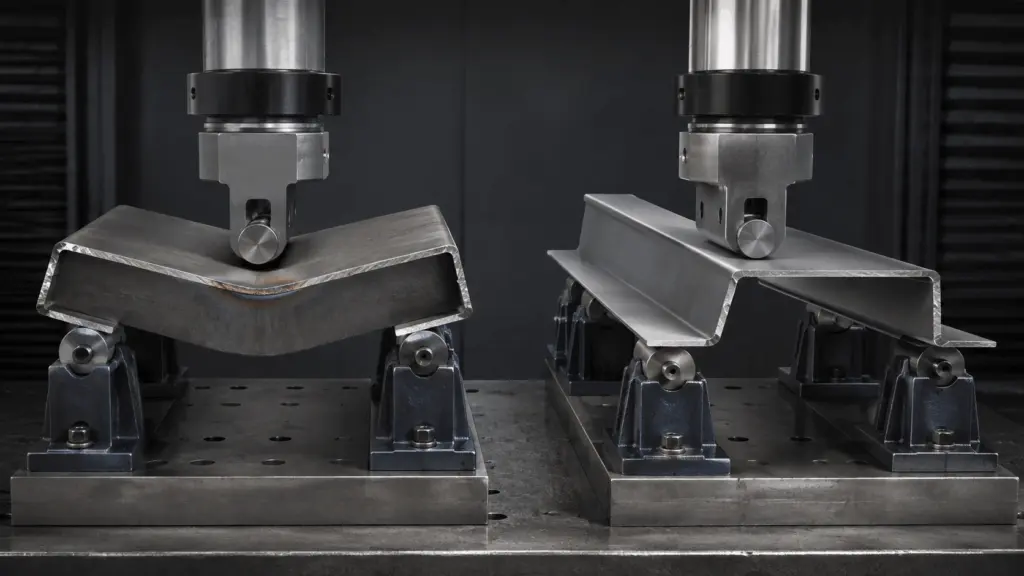
7. Bending radius determines which cross-sectional geometries can be fabricated
Thickness reduction often needs to be accompanied by geometric changes to control deflection and stability.
One option is to use deeper sections, formed ribs or U-shaped sections.
However, the ability to create these shapes depends directly on the bending radius permitted by the material.
According to transverse 180° bend-test data in perform® documentation, bending radius changes significantly as the yield strength grade increases.
The values above are taken from perform® product documentation for bend testing according to ISO 7438.
They represent results under the stated test conditions and should not be used directly as recommended bending radii for every actual fabrication condition.
The key point is:
A higher yield strength grade does not necessarily mean better formability.
A lower grade that can be bent to a smaller radius may allow a deeper section to be formed, which can increase geometric stiffness without necessarily increasing mass.
This is one reason why the most appropriate steel grade is not always the highest grade available.
8. Rolling direction also affects bendability
Bending radius depends not only on steel grade and thickness.
The bending direction relative to the rolling direction also needs to be identified.
Different bending directions should not automatically be assumed to use the same minimum bending radius.
The fabrication design therefore needs to specify:
- rolling direction of the plate
- bending direction
- actual thickness
- required bending radius
- parameters applicable to the specific material grade
The bending direction should be shown on the fabrication drawing rather than left for the workshop to choose according to the most convenient plate layout.
9. Three items required before including a steel grade in the design
Before considering thickness reduction using High-Strength Steel, at least three groups of information are required.
Without yield strength data, there is insufficient basis for evaluating structural strength requirements.
Without elongation data, the limits on deformation capability cannot be properly assessed.
Without bending-radius data, it is not possible to determine whether the cross-section shown on the drawing can actually be fabricated from the selected material.
These three items need to be considered together rather than as separate values.
10. Increasing yield strength does not resolve all effects of thickness reduction
When thickness is reduced, several mechanical parameters change at the same time.
In the flat-plate model presented in the overview article:
- stress increases
- deflection increases
- buckling resistance decreases
Higher yield strength can help address the strength requirement as stress increases.
However, increasing yield strength does not directly increase the geometric stiffness of a plate with the same elastic modulus and geometry.
The structure therefore still needs to be checked separately for:
- deflection
- local stability
- stiffener arrangement
- cross-sectional geometry
- dynamic loading and fatigue
This is the point where the problem moves from material selection to structural design.
These issues are examined in detail in Part 3: Three technical limits when reducing thickness: Deflection, local buckling and fatigue.
11. What can be checked in the workshop?
Not every mechanical property can be determined directly in the workshop.
Yield strength or elongation should not be inferred from:
- the sound produced when tapping the plate
- visual observation of thickness
- bending the material by hand
- the fact that the material has not fractured after several straightening attempts
These observations do not replace mechanical-property test results.
12. Responsibilities of the different functions
The workshop needs to participate from the solution-selection stage, particularly when the design depends heavily on formability.
A steel grade may satisfy the structural calculations but still make the solution difficult to implement if the workshop cannot form the required geometry.
13. Notes on applying this knowledge
First, specific mechanical-property values need to be taken from the correct data sheet for the material grade and the applicable document version. A single value should not be applied to the entire High-Strength Steel group.
Second, elongation values should only be compared when they use the same test basis. If the gauge lengths differ, the values should not be placed side by side and used for direct comparison.
Third, the radius used in a bend test should not automatically be treated as the recommended production bending radius. Fabrication needs to follow the applicable manufacturer guidance, plate thickness, rolling direction and actual workshop equipment.
Fourth, yield strength is used to evaluate structural strength requirements, but it does not by itself resolve deflection or stability when thickness is reduced. These issues need to be calculated separately according to structural geometry.
Fifth, increasing the steel grade may change formability. Material grade selection therefore needs to be considered together with the required bending radius and cross-sectional geometry.
Sixth, this article identifies the material properties that need to be reviewed and the appropriate selection sequence. It does not replace structural calculations for a specific vehicle design.
A thickness-reduction solution is only practical when the selected steel grade satisfies both sides of the problem: sufficient strength for the structural design and sufficient formability for the fabrication process.
Selecting a grade that is too low may fail to meet load requirements, while selecting a grade that is too high but cannot be formed into the required geometry provides no structural advantage. The appropriate steel grade is therefore the one that satisfies both the calculations and the selected fabrication approach.