Part 6: Demonstrating truck body load-carrying capacity through documentation and actual inspection
A lighter truck body only has value if the manufacturer can demonstrate that the structure still meets its load-carrying requirements and performs as designed after tare weight has been reduced.
The difficulty is that vehicle buyers may not always be able to interpret structural calculations or material certificates. A familiar way of judging the structure may instead rely on a perception of thickness, such as tapping the side wall to see whether it feels “solid”.
For this reason, in addition to technical documentation, the manufacturer needs a way to demonstrate structural performance that is visual, easy to check and repeatable on the actual vehicle. The objective is not to replace calculations with a simple measurement, but to help the buyer understand the relationship between material, structural design and actual structural behavior.
1. Thickness alone does not demonstrate load-carrying capacity
Tapping a truck body side wall may give an impression of plate thickness or local stiffness, but it does not indicate:
- the yield strength of the steel
- structural deflection under full load
- whether the structure returns to its original condition after unloading
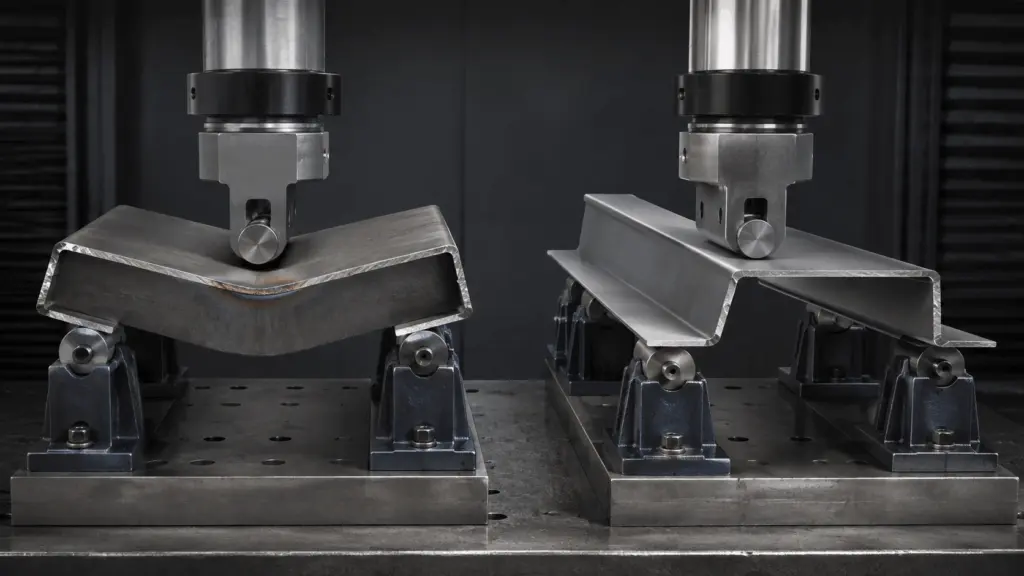
- how stiffeners and cross-sectional geometry compensate for reduced thickness
- whether welded connections meet dynamic load requirements
Two steel plates with different thicknesses may belong to different material grades and form part of completely different structural designs.
When explaining why a thinner truck body can still meet its load requirements, the manufacturer therefore needs to shift the focus from perceived thickness to material data, structural design and actual deformation.
2. Three layers of evidence need to work together
The load-carrying capacity of a structural weight reduction solution can be demonstrated through three layers of evidence.
These three layers do not replace one another.
Material documentation does not demonstrate that the entire structure has sufficient load-carrying capacity.
Structural calculations do not replace confirmation that the correct material was actually used.
A deflection measurement does not replace calculation of the allowable deflection.
When used together, the three layers create an evidence chain from:
Material → Design → Observed performance on the actual vehicle
3. Measure deflection so the buyer can observe structural behavior directly
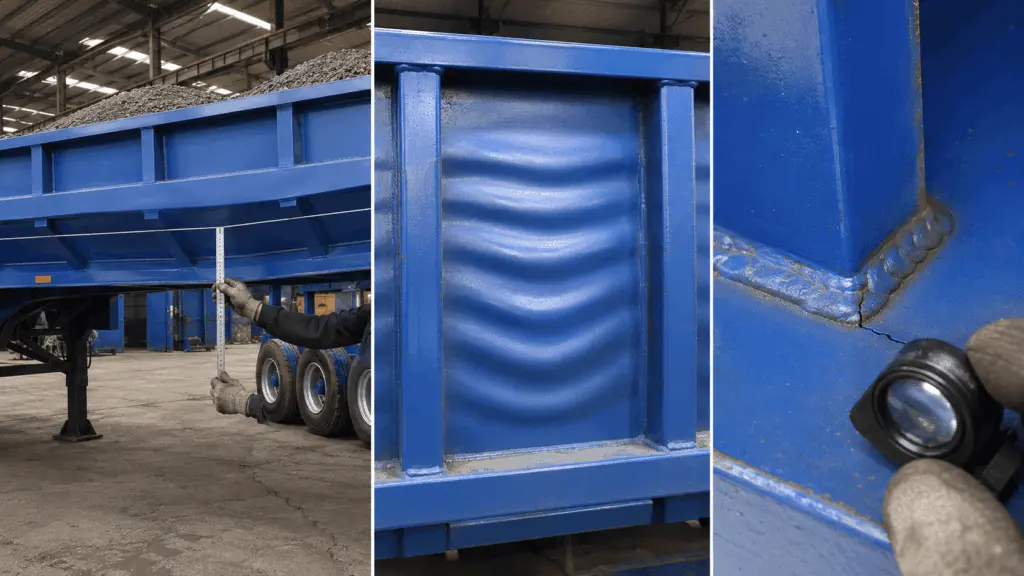
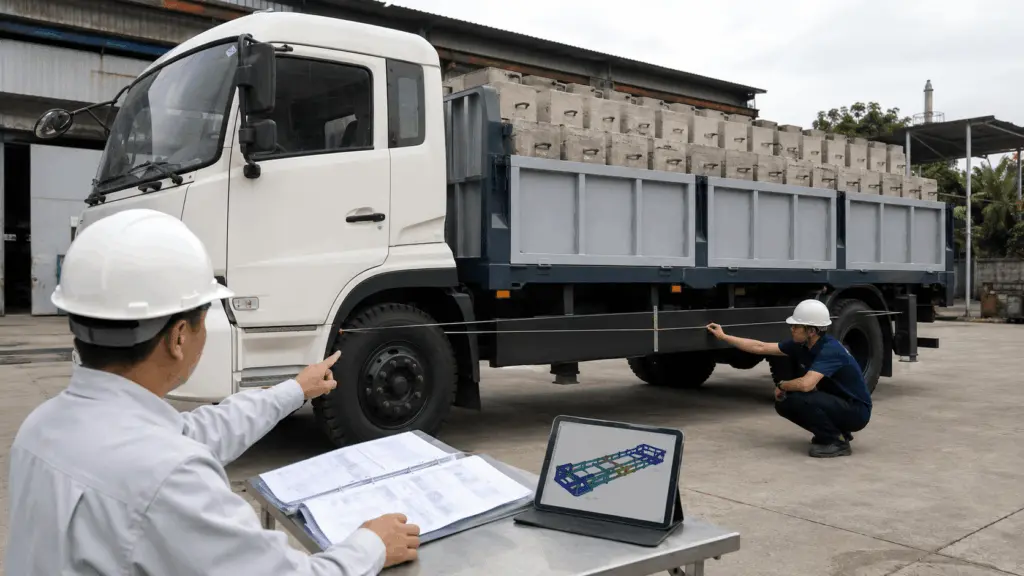
A simple inspection can use a tensioned line and ruler to record floor deflection.
The important point is to keep the measurement method and position the same.
If the structure returns to its original condition, or close to the original condition according to the defined criterion, after unloading, the observed deformation is elastic.
If it does not return, permanent deformation may have occurred and needs to be evaluated.
This measurement allows the buyer to observe two different structural states directly:
Under load → the structure deforms
After unloading → the structure recovers or does not recover
However, the measurement only shows the actual deflection under the inspection condition. Whether that value is within the allowable limit still needs to be checked against the structural calculations and design requirements.
4. Three figures help explain why a truck body can be thinner
When a buyer questions a reduced plate thickness, simply saying “the new steel is better” or “this steel has higher strength” is usually not enough.
The manufacturer should provide three specific pieces of information.
The third point is particularly important because the buyer can often see it directly on the vehicle.
For example, if thickness is reduced while a flat plate with many stiffeners is replaced by a deeper formed section, the structural change can be visually identified.
The explanation is then no longer:
“The steel plate has become thinner.”
Instead, it becomes:
“The material, thickness and cross-sectional geometry have been recalculated as a new structural solution.”
5. Documentation that should accompany a structural weight reduction solution
A structural weight reduction solution should not end with the fabrication drawing.
The documentation needs to allow the relevant parties to verify the basis of the design.
The tare-weight comparison should be broken down by component rather than giving only one total number.
For example:
- how many kilograms were reduced from the floor
- how many kilograms were reduced from the side walls
- how the beam mass changed
- how much mass was added or removed through stiffener changes
This presentation shows which design decisions created the weight reduction, rather than presenting only the final result.
6. Technical documentation and buyer-facing information should use different levels of detail
The workshop and the end buyer do not need to read the same information in the same way.
The documentation can be divided into two levels.
Buyer-facing information should not be simplified until it becomes only a sales message.
It still needs to show:
- why thickness can be reduced
- how the material has changed
- where structural geometry has been modified
- what the buyer can inspect on the vehicle
- which limits still depend on technical calculations
A short document containing specific data is more useful than a page that simply claims the structure is “lighter but still strong”.
7. Define in advance how the material advantage will be used
When a material with improved properties is introduced, not every solution needs to reduce thickness.
The material advantage can be used in two different ways.
These two approaches lead to different structural solutions.
If the customer prioritizes service life, the manufacturer may retain part of the original thickness rather than using the full material advantage for weight reduction.
If the objective is increased payload capacity, the design will focus more strongly on identifying where thickness can be reduced or cross-sectional geometry can be changed.
The objective therefore needs to be confirmed before calculations begin, not after the design has already been completed.
8. Reference cases demonstrate possibility, not a guaranteed reduction percentage
This knowledge series includes four cases with different recorded weight reductions.
These examples can be used to demonstrate that structural weight reduction through material and design changes has been achieved in practice.
However, they should not be used as default reduction percentages for another truck body.
Each case has a different:
- starting point
- original thickness
- cross-sectional geometry
- cargo type and operating conditions
- level of previous optimization
The reduction percentage for any particular design can therefore only be determined after data from that specific design is available.
9. Some performance aspects can only be confirmed more clearly after operation
A good technical package should also identify what cannot be fully demonstrated at the time of vehicle delivery.
Fatigue calculations may target a design life based on defined assumptions.
This does not mean that every vehicle operating under every condition will achieve exactly the same number of cycles.
Similarly, a single deflection measurement when the vehicle is new cannot represent the full structural condition after several years of operation.
Post-service data is therefore a necessary continuation of the initial documentation.
10. Post-delivery monitoring creates actual operating data
Monitoring can be organized at three stages.
Immediately after delivery
Measure deflection under the defined load condition to establish a baseline.
Record:
- measurement position
- load condition
- distance between measurement points
- result under load
- result after unloading
- field photographs
After 6 months
Repeat the same method to check for changes relative to the baseline.
If operating conditions have changed significantly, record this to avoid comparing results from two non-equivalent conditions.
After 1 year
Measure deflection again and inspect the connection areas that need monitoring, particularly those exposed to dynamic loading or identified during the design stage.
These three intervals are proposed monitoring points, not mandatory inspection cycles for every vehicle type.
The main value of the data series is comparability over time.
If the same design continues in production, data from the first vehicles can help the manufacturer review design assumptions and improve the documentation for subsequent vehicles.
11. How to organize a one-page inspection guide for the buyer
A short inspection guide can be organized into four sections.
Inspection conditions
State the required load condition and vehicle position.
Measurement position
Mark the exact location on an image or drawing so that the same point can be used again.
Measurement method
Explain how to tension the line, position the ruler and record the value.
How to interpret the result
Explain clearly that:
- deflection under load does not automatically mean damage
- the structure needs to be measured again after unloading
- non-recoverable deformation is a sign that requires technical evaluation
- actual measured deflection does not replace the allowable deflection defined by the structural calculation
This approach allows the measurement to be repeated months later without depending on the person who performed the first inspection.
12. Responsibilities of the different functions
The buyer can perform the deflection measurement directly according to the provided guidance.
The important point is that the same method needs to be used at different measurement times so that the data remains comparable.
13. Notes on applying this knowledge
First, measuring deflection with a tensioned line and ruler helps record actual deformation and distinguish the condition before and after unloading. This measurement does not determine the allowable deflection by itself.
Second, truck body load-carrying capacity needs to be demonstrated through the combination of the actual material, structural calculations and fabrication records. No single layer of evidence replaces all the others.
Third, published structural weight reduction cases are reference examples only. The reduction achieved in another case should not be used as a commitment for a vehicle that has not been weighed and recalculated.
Fourth, fatigue life depends on repeated loading during operation. A calculation provides a design life based on defined assumptions, not an absolute guarantee under every operating condition.
Fifth, post-delivery monitoring needs to use the same method and sufficiently comparable conditions for the results to remain meaningful.
Sixth, the vehicle should not be deliberately overloaded simply to demonstrate load-carrying capacity. Evaluation needs to remain within the design conditions, operating limits and requirements applicable to the vehicle.
A lighter design becomes more convincing when the buyer is not only given an explanation but can follow the complete basis of the solution: which material was used, how the structure was calculated, where the weight was reduced and how the vehicle deforms under actual load.
When this information is recorded from delivery and then compared during operation, the value of the structural weight reduction solution is demonstrated through the operating records of the structure itself.