Part 1: What do material certificates and documents prove?
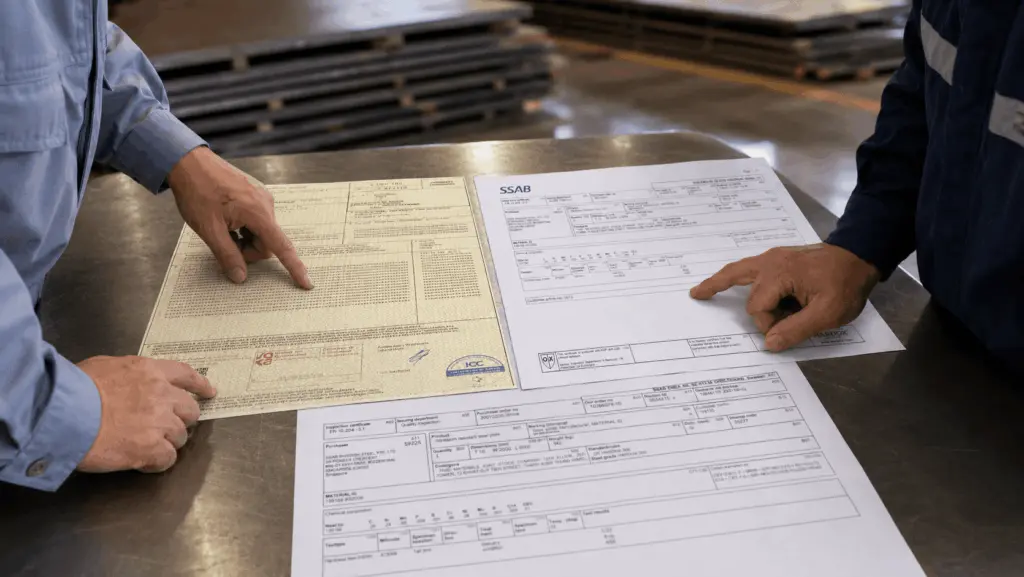
A material batch may be delivered with complete certificates, batch numbers and delivery documents. However, each type of document has a different scope of confirmation and a different evidential value.
Some documents help establish the origin of the material, some certificates record chemical composition and mechanical properties, while certain test results may be based on the actual delivered batch or on products of the same type tested under the manufacturer’s procedures.
To use these documents correctly, quality and procurement teams need to identify the certificate type, the validating party, the basis of testing and the relationship between the documentation and the actual material. These requirements should be clarified at the ordering stage rather than checked only during acceptance inspection.
1. Two certificates may look similar but provide different levels of evidence
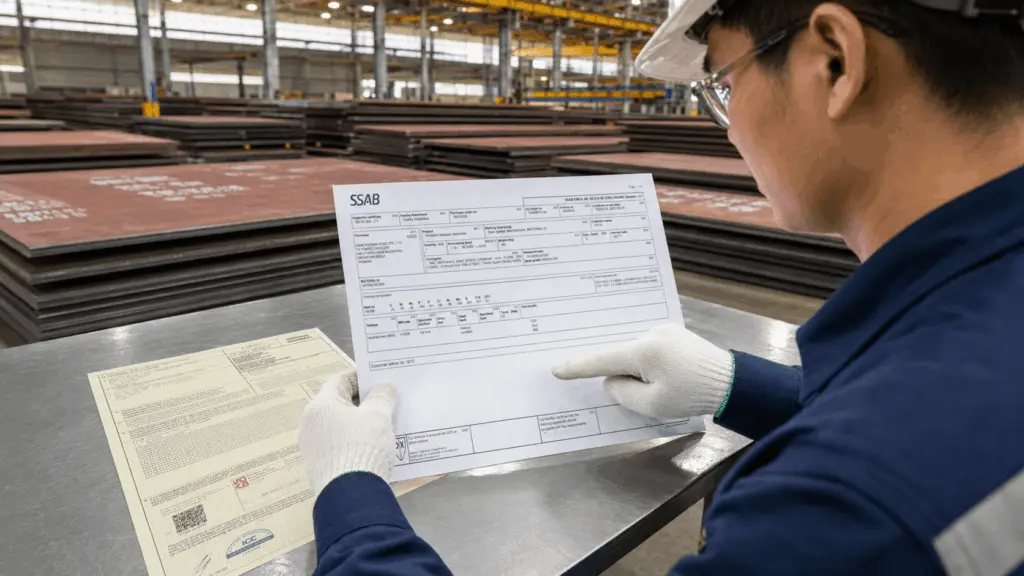
Under EN 10204, inspection documents for metallic products are distinguished mainly by two factors: who validates the results and the basis on which the inspection is performed.
This distinction is particularly important when the plant intends to use test results as a basis for acceptance inspection.
1.1. Non-specific inspection
Non-specific inspection is carried out by the manufacturer under its own procedures, and the products tested do not necessarily belong to the actual batch being delivered.
The results stated in the document remain valid within the scope of that document type. However, they should not automatically be treated as direct measurements of the specific material batch under acceptance inspection.
When using documents in this category, the quality department therefore needs to understand clearly what the results actually represent.
1.2. Specific inspection
Specific inspection is performed on products from the delivered batch or on an inspection unit defined by the applicable requirements.
The results therefore have a direct relationship with the material batch being accepted.
If the plant requires test results linked to the actual delivered batch, the requirement for specific inspection needs to be defined before the order is placed.
The evidential value of a certificate depends on the basis used to generate the results and the degree of independence in validation, not on the appearance of the document.
The applicable document types and designations should be checked against the version of EN 10204 specified for the order.
2. What information can an inspection certificate confirm?
An inspection certificate confirms material information within the scope of its declared content. However, it does not replace data used to assess suitability for an application or actual operating performance.
A batch of steel may fully comply with all declared properties and still degrade prematurely if the operating conditions are unsuitable.
Conversely, early component failure is not, by itself, sufficient evidence that the delivered material does not comply with its certificate.
Material quality according to declared properties therefore needs to be distinguished from material suitability under actual operating conditions.
A certificate is part of the evidence used in material inspection and acceptance inspection. Selection for a specific operating position still needs to be based on technical data from that position.
Further details on the division of responsibility between the manufacturer, the material selection function and the installation contractor are provided in Part 5: Acceptance criteria and responsibility for material selection.
3. Determine the certificate type before ordering
The required certificate type should be selected according to the plant’s technical requirements and acceptance inspection purpose.
Before the order is confirmed, the quality and procurement teams need to clarify three points:
If results linked to the actual delivered batch are required, the selected certificate type needs to meet the requirements for specific inspection.
If validation independent of the production function is required, this also needs to be stated clearly in the order.
A general requirement such as “provide quality certificate” may result in the supplier providing documentation that does not meet the level of evidence required by the quality department.
Once the material has already been produced and delivered, it cannot be assumed that the supplier can simply change to another certificate type or add test results under the originally intended conditions.
The certificate type therefore needs to be defined before ordering and stated clearly in the procurement documentation.
4. Documents required when receiving a material batch
A material batch should be managed through a set of documents that links production information, inspection results and delivery data.
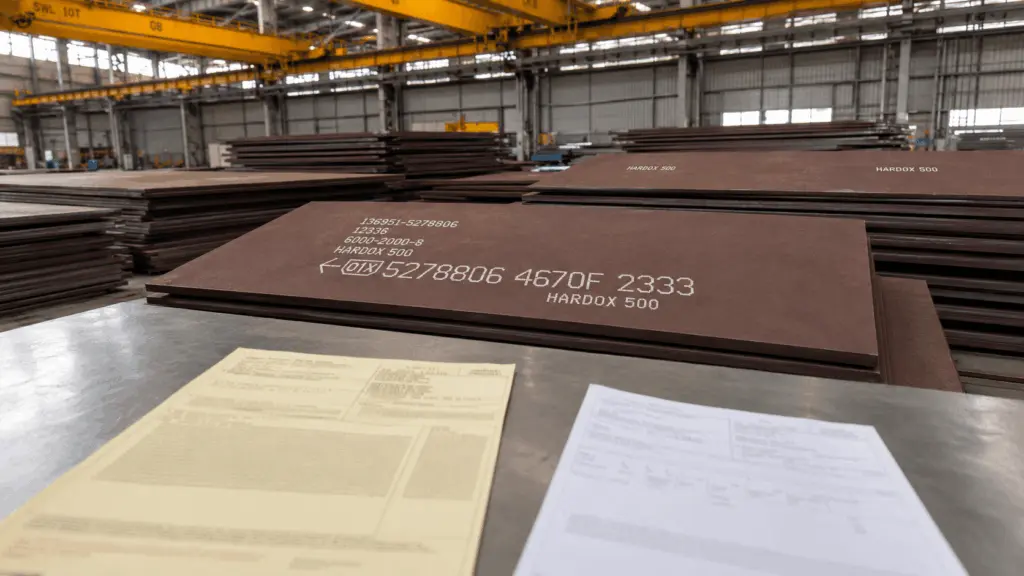
Within this documentation set, the identification number is a key link between the documents and the actual material.
If a certificate contains complete property data but the identification number cannot be matched to the material being received, the documentation does not provide sufficient basis to confirm a direct relationship between the certificate and the batch.
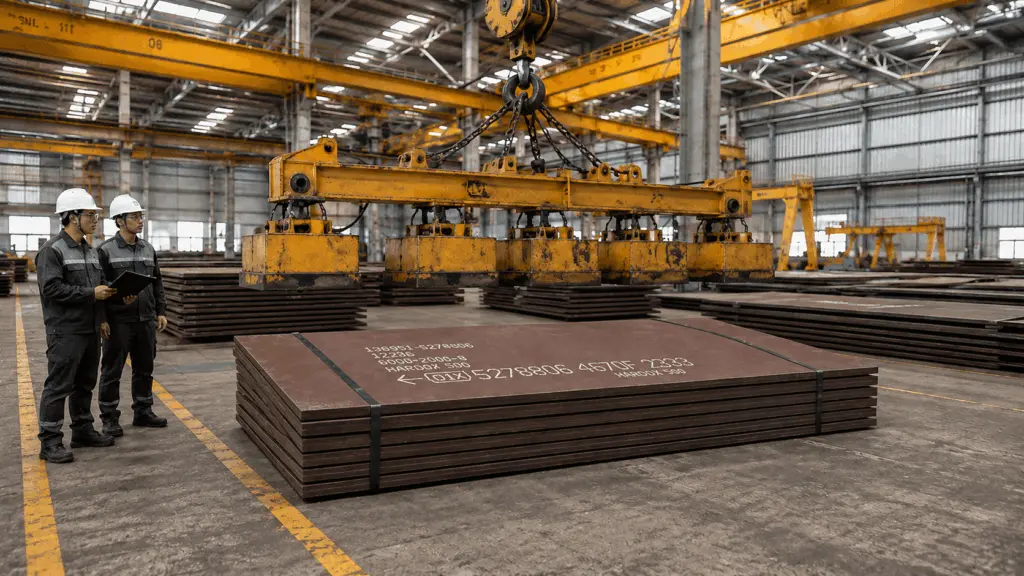
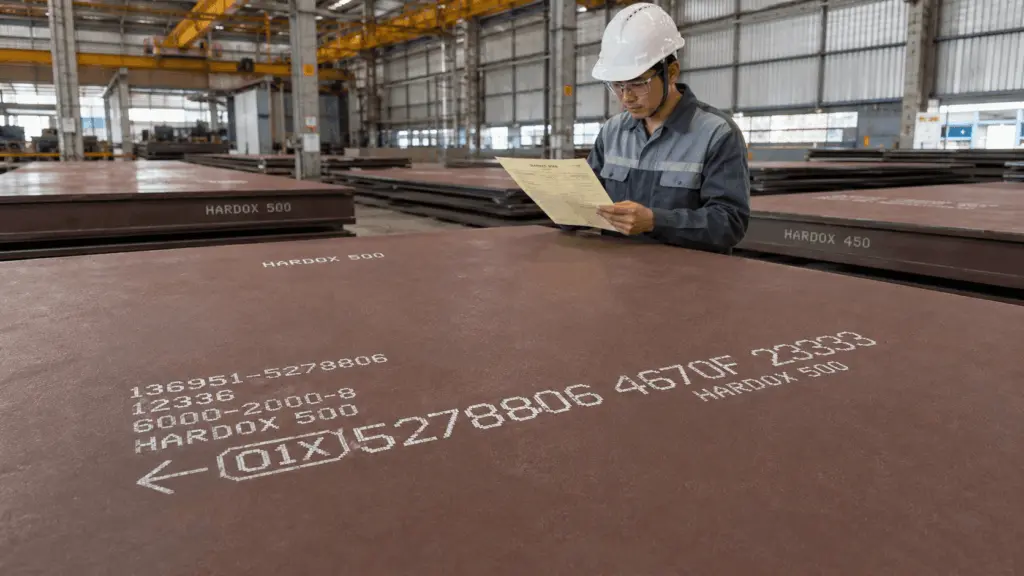
For example, when receiving steel plate, the warehouse and quality department need to compare the identification number on the material with the information on the certificate.
If the numbers do not match or the identification marking cannot be read, the issue needs to be clarified before the traceability record is accepted.
Further details on maintaining the traceability chain during receiving, plate cutting and machining are provided in Part 4: Traceability and identification of material from an incorrect source.
5. Four items to check on an inspection certificate
When an inspection certificate is provided, the quality department should verify four items before using it as a basis for acceptance inspection.
5.1. The certificate type needs to match the order
A certificate described as providing a higher level of validation does not necessarily replace the type that was originally agreed.
If the certificate delivered differs from the requirement, the quality department should review the order and clarify the difference with the supplier before acceptance.
The basis for evaluation is the certificate type agreed in the order, not simply a general judgment that one document appears more complete than another.
5.2. The identification number needs to match the material
The identification number on the certificate and the identification on the material should be checked in full.
If there is any discrepancy, even a single character, the traceability chain has not yet been confirmed.
If the identification marking is faded or unreadable, receiving records and other relevant evidence should be used for verification. The identification number should not be inferred solely from information provided by the supplier.
5.3. Material properties need to be interpreted according to their declaration level
Not every value appearing in technical documentation has the same level of assurance.
For example, a typical value for yield strength may help the technical team understand the material’s characteristics, but it should not be used as a guaranteed value for acceptance inspection unless this has been appropriately agreed.
Similarly, a hardness value converted from another measurement does not have the same evidential basis as a directly measured hardness result.
Before including a material property in acceptance criteria, it is therefore necessary to identify both its declaration level and the method used to generate the value.
5.4. The applicable standard version needs to be identified
A standard number may be revised, replaced or withdrawn over time.
If a certificate states only the standard number without identifying the applicable version, the two parties may use different versions when carrying out verification.
The quality department should therefore check the standard information stated on the certificate and compare it with the version agreed in the order.
A certificate may contain complete numerical data and still be insufficient for a specific acceptance purpose if the declaration level, basis of inspection or applicable standard version is unclear.
6. Collect and file documents at the time of receiving
Documents should be collected when the material is received so that identification numbers, dimensions and delivery information can be checked at the same time.
Once the batch enters storage, records should be filed by batch number and identification number, not only by supplier name.
This approach makes it easier to retrieve information after the material has been cut, welded or machined into multiple components.
If documents are not linked to the batch from the beginning, the plant may later retain all the paperwork but still be unable to determine which document belongs to the component currently in use.
Document verification is therefore part of the receiving process and should not be treated only as an administrative filing task performed afterwards.
7. Determine the applicable document when both original and translated versions are available
For imported materials, certificates and technical documents may be supplied in more than one language.
During translation, terminology or wording may differ between versions. It is therefore necessary to define which document version will be used as the basis for verification.
The governing document should preferably be defined at the contract or ordering stage.
If the parties wait until a dispute arises before deciding which version applies, it may be more difficult to agree on the basis for evaluation.
8. Three common documentation issues during acceptance inspection
8.1. The certificate does not clearly identify the applicable standard version
If a document states only the standard number without identifying the applicable version, verification may become difficult if the standard has since been revised.
The quality department should request clarification of the version used to generate the results.
8.2. Guaranteed values and typical values are not distinguished
A typical value may be suitable for reference, but it should not automatically become a mandatory limit in acceptance inspection documentation.
If the declaration level is used incorrectly, the purchaser may lack sufficient basis when asking the supplier to explain a non-conforming result.
8.3. The identification number on the material cannot be read
This directly affects traceability.
The certificate may still be complete, but if the identification marking cannot be read and no alternative linking record exists, it becomes difficult to confirm that the certificate belongs to the actual material being inspected.
In this case, the identification chain needs to be verified before the documentation is accepted.
9. Responsibilities of the different functions
Certificate management begins when procurement requirements are defined and continues until the documentation is filed against the material batch.
Among these activities, determining the certificate type before ordering has a direct effect on whether the required evidence can be collected later.
If the requirement is not specified from the beginning, the quality department may only discover that a certificate or test result is missing after the material has already arrived at the warehouse. At that point, not all missing data can necessarily be added under the originally required conditions.
10. Notes on applying this knowledge
First, EN 10204 specifies inspection documents for metallic products. This article focuses on the principle of distinguishing them according to the validating party and the basis of inspection. The designation and detailed requirements of each document type should be checked against the version of the standard applicable to the order.
Second, certificates provide evidence about the material and the declared properties within their applicable scope. They do not, by themselves, demonstrate suitability for the operating conditions or service life at a specific position.
Third, the declaration level of each property needs to be identified before the value is used as an acceptance criterion. Typical values and converted values should not automatically be treated as guaranteed values.
Fourth, the approach to translated documents and the common documentation issues described in this article are based on practical organization of the acceptance inspection process and are not presented as separate requirements of EN 10204.
Fifth, this article does not interpret the legal effect of certificate types or contractual responsibility. These issues should be considered separately according to the applicable agreements and legal basis.
An inspection certificate only becomes useful in acceptance inspection when it is the correct type for the order, has a clear basis of inspection and can be linked to the actual material batch. Defining the requirement at the ordering stage, checking the documentation in full at receiving and filing the records by batch help the plant maintain evidence for quality inspection and traceability when needed.