Part 4: Traceability and identification of material from an incorrect source
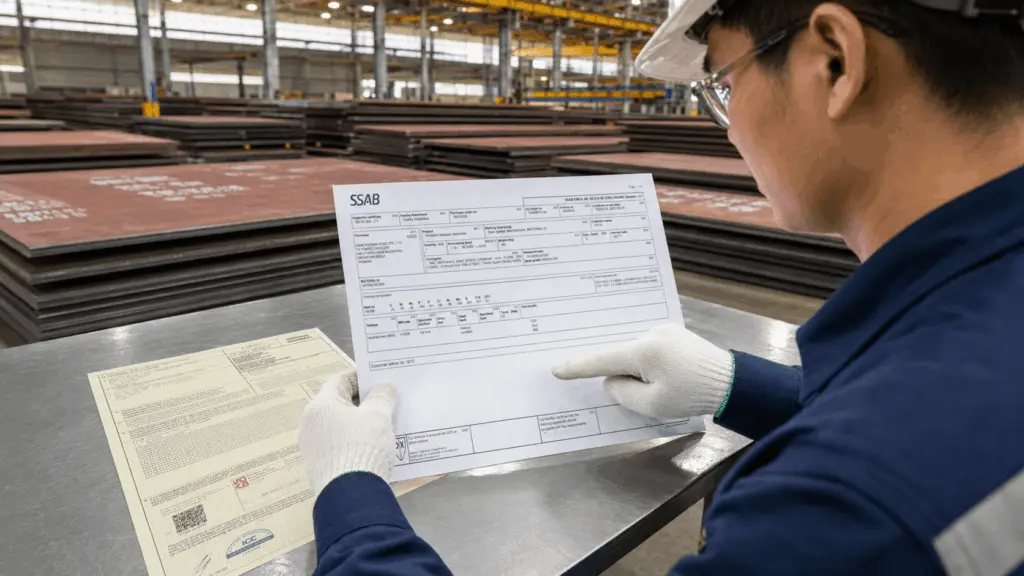
A steel plate may enter the warehouse with complete certificates and identification markings. However, once it is cut into multiple components, only one section may retain the original identification. The remaining components may then be machined, installed or returned to storage without any information linking them back to the original plate.
If the plant later needs to verify material quality or confirm the material source, it may no longer be possible to identify the corresponding certificate even though the original documentation has been retained.
For this reason, traceability is not limited to checking documents at receiving. It also requires maintaining the link between the material, batch information and records throughout machining and installation.
This article focuses on identifying unusual signs, maintaining traceability after material is cut, and handling cases where the material source has not yet been verified.
1. Information required in the material traceability chain
For industrial steel plate, the traceability chain needs to link production data, material identification and the corresponding documentation.
Four links need to be managed:
These items need to remain linked.
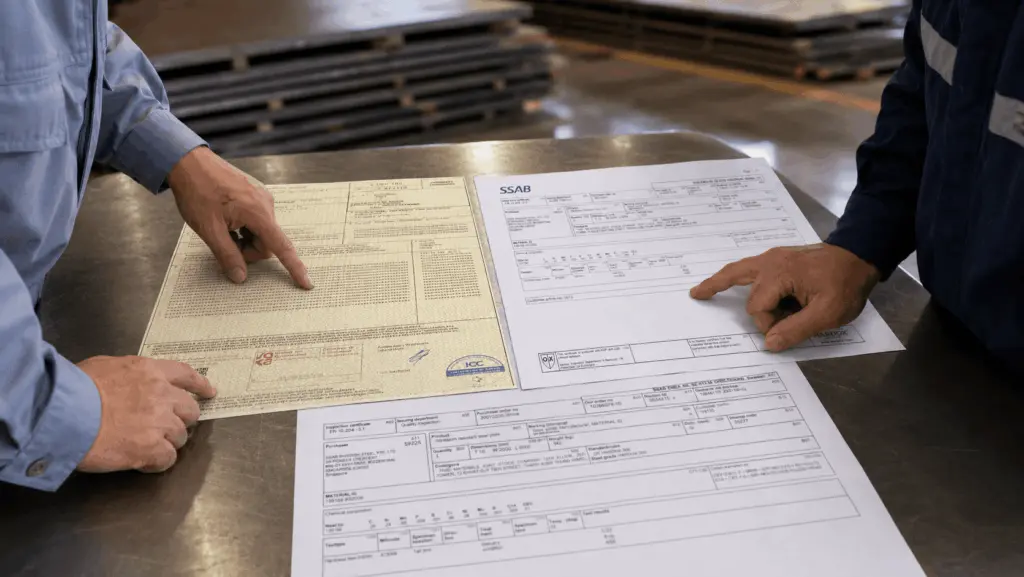
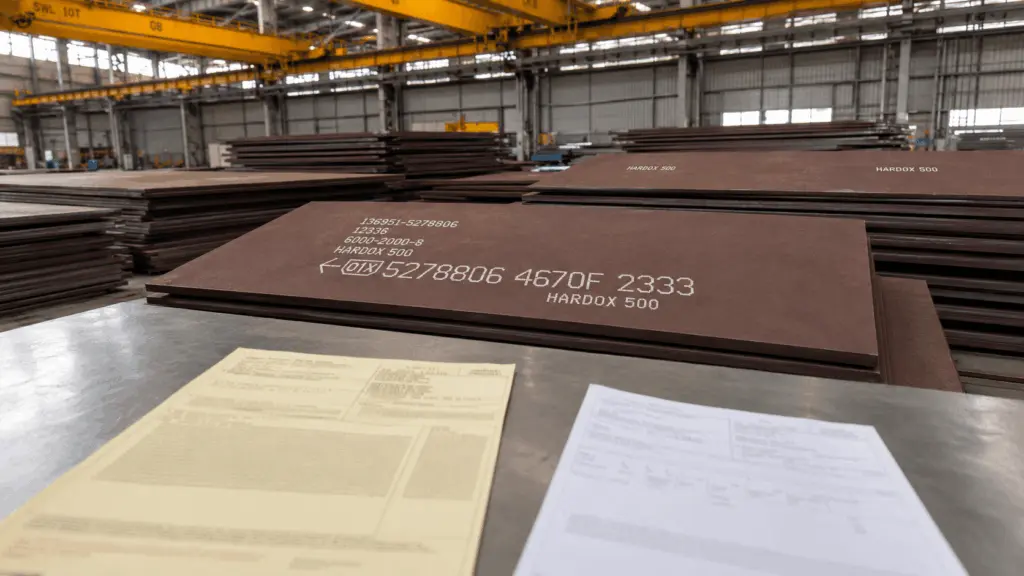
For example, when matching a steel plate to its certificate, the quality department needs to verify that the identification number on the material matches the information recorded in the documentation.
If a certificate is available but it cannot be established which steel plate the certificate belongs to, the traceability chain is incomplete.
Conversely, a stamped number on the material does not by itself prove the material source if there is no corresponding documentation for verification.
Verification should therefore be based on the relationship between the records rather than on a single identification mark.
Further details on the evidential value of different certificate types are provided in Part 1: What do material certificates and documents prove.
2. Distinguishing stamped numbers, paint markings and labels
During storage and machining, materials may be identified in several different ways.
However, these identification methods do not provide the same level of evidence when verifying material source.
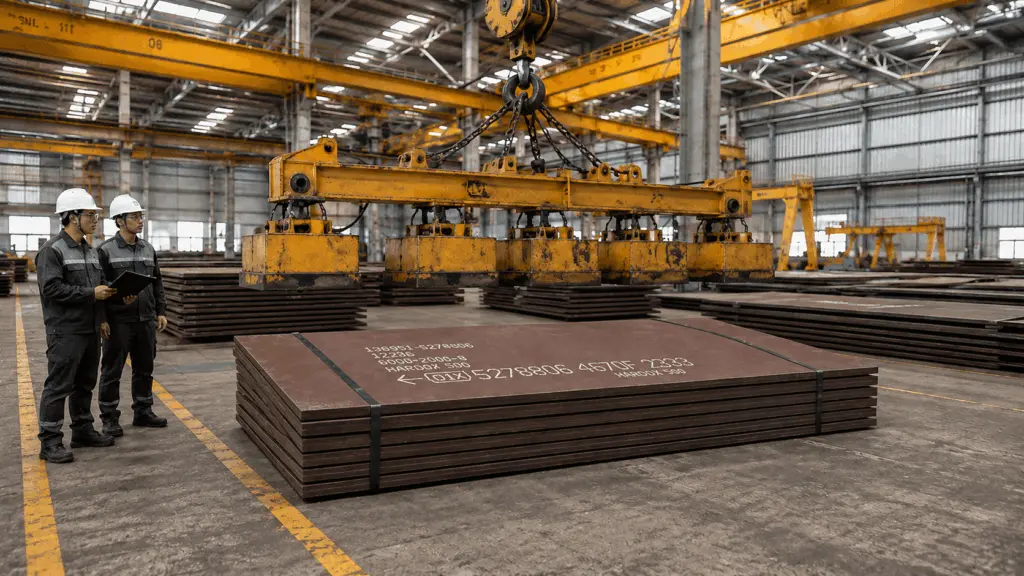
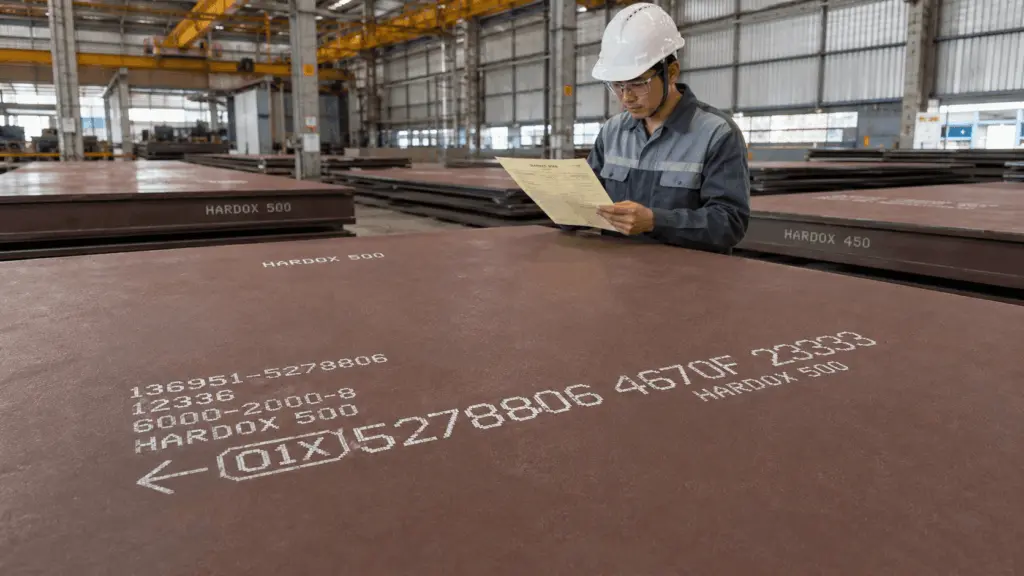
A number stamped directly on steel plate generally provides stronger traceability than paint markings or labels because it is applied directly to the material.
However, the stamped number does not by itself confirm the authenticity of the material. Traceability is established only when the identification number can be matched to the certificate and related records.
For some thin products or products supplied in bundles, identification may be managed through batch numbers, bundle labels and delivery documentation rather than a stamped number on every plate.
In such cases, the documentation chain needs to be organized according to the product’s identification method.
3. Four situations that can break the traceability chain
A material batch may be fully controlled when it enters the warehouse but lose its source link during machining.
Four situations require particular attention:
3.1. Cutting the plate before transferring identification information
This is a situation that can easily occur in the workshop.
A steel plate may have a stamped number at one specific location. Once the plate is cut into multiple components, only the section containing that number retains the original identification.
If the remaining sections are not marked separately, identifying the source of each component may depend on memory or incomplete workshop records.
For this reason, identification information needs to be transferred before the plate is cut.
3.2. Machining removes the identification number
A stamped number may be removed by grinding, drilling, milling or other machining operations performed at the identification location.
Before work begins, the workshop should photograph and record the material code.
If the original identification cannot remain on the finished component, the linking code needs to be maintained in the fabrication records.
3.3. Remnant material is returned to storage
Material remaining after cutting may later be used for other orders or components.
If traceability information is not retained, the warehouse may only know the dimensions and material type stated on a temporary label without having enough data to identify the original batch.
Each remnant should therefore have a temporary identification code and a record linking it to the original plate.
3.4. Documentation is not transferred completely
When material passes through multiple intermediaries, the documentation can become separated from the physical material.
For example, the receiving party may receive only a delivery note and dimensional information without sufficient records to link the material to its inspection certificate.
In this situation, procurement needs to coordinate with the supplier to complete the documentation chain before the material source is confirmed.
4. Procedure for transferring identification information when cutting steel plate
To maintain traceability after fabrication, identification transfer can be organized in four steps.
4.1. Record data before cutting
The photographs need to show both the material plate and the original identification number.
A close-up image of the stamped number alone should not be used if it does not provide enough context to identify which plate the marking belongs to.
If several plates are processed at the same time, the images and records need to be organized so they cannot be confused between plates.
4.2. Assign temporary codes according to the cutting plan
Each component after cutting needs to receive a temporary code corresponding to the prepared cutting plan.
This allows the fabrication team to identify which plate each component came from even when the original stamped number is no longer present.
The temporary code needs to remain linked through subsequent operations until corresponding handover or installation records are available.
4.3. Link the material code to the fabrication release records
When the component is completed and handed over, the fabrication release records need to identify the material code used.
This enables reverse traceability from the finished component through:
Fabricated component → Temporary code → Original plate → Batch number → Inspection certificate.
This provides the basis for tracing material source when quality verification or post-installation failure assessment is required.
5. Identifying signs of material with an unverified source
During receiving, the warehouse and quality department may identify unusual signs related to packaging, identification markings or documentation.
However, one unusual sign alone is not sufficient to conclude that the material comes from an incorrect source or is counterfeit.
The following signs should only be used to identify cases requiring additional verification.
These signs may result from changes in packaging, preservation procedures or document format.
They should therefore not be used as standalone evidence that the material comes from an incorrect source.
If two or more unusual signs are identified, the warehouse and quality department should record and report them so that additional verification can be arranged.
This threshold is an internal management warning level, not a technical-standard criterion for identifying counterfeit material.
6. What to do when the material source cannot yet be verified
If the identification number does not match or several unusual signs are identified, the material batch should be withheld from use until verification is complete.
The process can be organized in four steps:
The important point is to maintain controlled status for the material batch throughout the verification process.
The material should not be released, returned or declared counterfeit without sufficient evidence.
If the source is fully verified, the batch can continue through the normal receiving and acceptance inspection process.
If the relationship between the material and the certificate still cannot be established, the batch should remain segregated until a handling decision is made according to the applicable agreement.
7. Traceability for thin steel plate without stamped identification
Not every steel product has a stamped identification number on each individual plate.
For some thin products or products supplied in bundles, identification may be managed through batch codes and bundle labels.
In this situation, three groups of evidence can be used:
These three groups of information need to be recorded at the same time during receiving.
If the bundle has already been opened, divided or moved into fabrication before photographs and records are prepared, traceability may be limited.
For materials without a stamped identification number on each plate, receiving records and batch codes therefore play a particularly important role in maintaining the traceability chain.
8. What should traceability records be able to answer after several years?
The value of traceability does not end at the time of receiving.
After a component has been installed and operated for several years, the plant may still need to determine what material was used, where it came from and the original basis for its selection.
A complete record should help answer five questions:
If the linking data from the original plate to the finished component is missing, determining the source of the component several years later may be difficult.
Similarly, if only the certificate is retained without material-selection and operating data, the plant still does not have enough information to evaluate how effectively the material performed.
Further details on retaining selection records, acceptance criteria and responsibilities are provided in Part 5: Acceptance criteria and responsibility for material selection.
9. Three common errors in managing traceability records
Of these, failing to transfer identification information after cutting can break the traceability chain directly in the workshop even when the initial receiving process was completed correctly.
Maintaining the material code should therefore be considered part of the fabrication process, not only a warehouse responsibility.
10. Responsibilities of the different functions
To maintain the traceability chain, each function needs to manage material information at the relevant stage.
Among these tasks, transferring identification information before cutting is a critical step in maintaining traceability from incoming material to the finished component.
Without this step, the documentation may remain complete but no longer be linked to the fabricated component.
11. Notes on applying this knowledge
First, an identification number marked directly on the material is an important link in the traceability chain, but it does not by itself prove material source or authenticity. It needs to be checked against the certificate and related records.
Second, paint markings, labels and packaging can support identification. These signs should not be used individually to conclude that the material is from the correct or incorrect source.
Third, unusual signs and the warning threshold of two or more signs are internal management guidelines, not criteria for identifying counterfeit material under a technical standard.
Fourth, when the material source has not yet been verified, the batch needs to be segregated and maintained under “Under inspection” status. It should not be declared counterfeit, released or returned before verification is complete and an appropriate handling decision has been made.
Fifth, for products without stamped identification on each plate, the traceability chain needs to be maintained through batch codes, bundle labels, receiving photographs and warehouse receiving records.
Sixth, traceability helps identify which material was used and the corresponding records. Whether the material is suitable for the application or achieves the expected service life still needs to be evaluated using technical data and operating performance.
An effective traceability chain needs to maintain the connection from the inspection certificate, batch information and incoming material through to each fabricated component. Accurate receiving records, identification transfer before cutting and batch-based document retention help the plant determine material source, inspect quality and address discrepancies that arise during service.