Part 4: Selecting anti-adhesion materials for material build-up and flow blockage
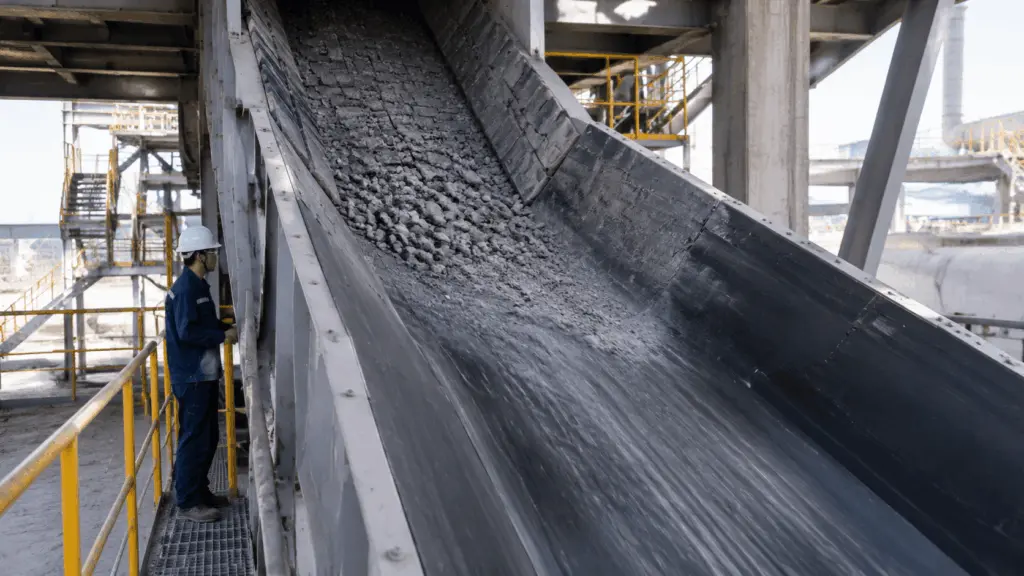
In wear-related applications, the objective is usually to select a material with suitable properties to reduce the gradual loss of the working surface during operation.
Material build-up and flow blockage follow a very different selection logic. In this case, the lining material is not being worn away. Instead, bulk material accumulates on the surface. As the build-up becomes thicker, the flow cross-section becomes smaller, throughput decreases, and the risk of blockage gradually increases.
For this reason, increasing hardness does not directly solve the problem. Material selection needs to focus instead on factors related to anti-adhesion performance, surface energy, material moisture and the actual sliding angle.
1. Wear protection and anti-adhesion are two different problems
These two problems have different selection objectives:
The key distinction is that hardness and low adhesion are not the same property.
A very hard material may still allow moist bulk material to adhere strongly. Conversely, a material with lower hardness may reduce build-up if its surface properties are better suited to the material being handled.
You can learn more about the formation of build-up, arching and ratholing in Part 3: Material build-up and flow blockage: formation mechanisms and identification signs in the Material Wear Mechanisms knowledge series.
2. Low surface roughness and anti-adhesion performance are not the same property
These two concepts are often treated as if they were the same.
Low surface roughness describes the geometric condition of a surface and can help dry particles slide more easily.
Surface energy, on the other hand, relates to the interaction between moist bulk material and the surface. A very smooth surface can still retain material if its surface characteristics are not suitable for the material being handled.
The four concepts can be separated as follows:
- hard: resistance to mechanical action
- soft: a lower level of hardness
- smooth: low surface roughness
- low adhesion: ability to limit material build-up on a surface under specific conditions
These four concepts are not interchangeable.
For example, a stone surface may be very hard and polished smooth but still retain wet mud. In contrast, a softer polymer surface may allow the mud to slide more easily because of different surface characteristics.
3. Adhesive wear must be distinguished from material adhesion and flow blockage from the beginning
In Vietnamese, the same word “dính” may be used for two different phenomena.
If these two concepts are confused, the selection approach may be incorrect from the very beginning.
For flow blockage, the objective is not to increase wear resistance. The objective is to reduce material adhesion and maintain material flow.
4. Temperature remains an exclusion criterion before anti-adhesion performance is compared
Even when adhesion is the primary problem, temperature still needs to be checked first.
A material group may provide good anti-adhesion performance, but if the operating temperature exceeds its allowable limit, it should no longer remain under consideration.
Ultra-high-molecular-weight polyethylene (PE-UHMW) provides the highest anti-adhesion performance in this table, but it also has the lowest temperature limit, approximately 80 °C.
Therefore, the material group with the most favorable surface properties for material flow is not necessarily the most suitable group for all operating conditions at the location.
These values are intended only for initial material-group screening. When selecting a specific grade, the current technical data sheet for that grade must be checked.
5. Moisture, adhesiveness and sliding angle should be evaluated together
Material adhesion requires its own set of operating data.
Three parameters should be considered:
These three parameters should be evaluated together.
If moisture is the main cause, changing the lining material may not address the source of the build-up.
If interaction between the bulk material and the surface is the dominant factor, Anti-adhesion Plastic may be worth considering.
If the angle or equipment geometry is the main cause, the problem needs to shift toward flow-design evaluation.
You can learn more about how these three parameters are measured and used in Part 4: Three parameters for evaluating material adhesion: moisture, adhesiveness and sliding angle in the Material Wear Mechanisms knowledge series.
6. Seasonal conditions should be included in the selection process
The moisture content of bulk material can vary significantly by season.
A location that experiences little blockage during the dry season but frequent blockage during the rainy season should not be evaluated based only on a single measurement taken under favorable conditions.
The inspection record should include:
- date of survey
- season in which the survey was conducted
- material moisture at the time of measurement
- season in which the most severe blockage occurs, based on operating data
Dry-season data should not be treated as representative of rainy-season conditions when the condition of the material changes significantly.
If a survey cannot be carried out during the most severe season, the representative limits of the available data should be clearly stated rather than using that data to infer conditions in another season.
7. When wear and material adhesion occur together, there are three main approaches
A location may be exposed to both particle wear and material build-up on the surface.
When both requirements exist, there are three main approaches:
The third approach is particularly easy to overlook.
If the root cause lies in flow geometry, changing the material may only delay the next blockage rather than eliminate the cause.
You can learn more about applications requiring multiple material groups at the same location in Part 5: Combining multiple materials at one location: design principles and interface control.
8. Changing the sliding angle can help narrow down the cause
One test that can help distinguish between a material-related issue and a geometry-related issue is to change the sliding angle, where operating conditions allow.
If increasing the angle does not prevent the material from blocking the flow, the influence of surface characteristics and lining material should be investigated further.
If increasing the angle restores material flow, the cause is more likely to be related to flow geometry.
This test does not establish a new design standard.
Its purpose is to help determine whether the investigation should continue toward anti-adhesion material selection or shift toward evaluating the angle, cross-section and configuration of the material flow path.
9. For flow blockage, measure accumulated material rather than only the remaining lining thickness
In a wear problem, the important data is the amount of lining material remaining.
For material adhesion, the key data to monitor is the amount of bulk material that accumulates on the surface.
Four pieces of information should be recorded:
- thickness of the build-up layer
- time required for the build-up to form
- locations where build-up is concentrated
- inlet and outlet moisture conditions, together with the actual angle of the sliding surface
The build-up area should be shown on a cross-sectional diagram to illustrate the relationship between the shape of the accumulated material, flow direction and equipment geometry.
If only photographs of the build-up are taken without recording its location, thickness and formation time, the data will be difficult to use for comparison after the solution is changed.
10. Blockage-clearing frequency should be converted into comparable operating data
Comments such as “frequent blockage” or “continuous blockage” are not sufficient for evaluating conditions before and after a solution is changed.
Intervention history should be converted into measurable data, for example:
- number of blockage-clearing interventions within a defined period
- labor time required for each intervention
- time between clearing the blockage and the next occurrence
This data should be taken from the operating log, rather than relying only on estimates from operators.
These figures help determine whether a new solution actually changes operating performance or simply delays the next blockage.
11. Responsibilities of each team
The role of the engineer assessing flow geometry is particularly important.
Without this step, the problem can easily default to changing the material, even when the actual cause lies in wall angle, cross-section or the configuration of the material flow path.
12. Notes on applying this knowledge
First, the three parameters of moisture, adhesiveness and sliding angle are not covered by a single standard that defines their complete use in this type of application. Any thresholds developed from actual operating data should clearly state their source and scope of application and should not be presented as an industry standard.
Second, sliding tests or assessments are only meaningful when the material conditions are kept consistent. Changes in moisture, particle size or sample condition may make the results no longer directly comparable.
Third, the material group with the highest anti-adhesion performance may not satisfy the other operating conditions at the location. Temperature, impact and wear still need to be checked before the solution is finalized.
Fourth, if flow geometry is the primary cause, changing the lining material does not replace the need to recalculate the angle or cross-section.
Material selection for adhesion-related problems begins by identifying why the bulk material is adhering, not by searching for a harder surface. Only when moisture, surface interaction and sliding angle are considered together is there a technical basis for deciding whether to change the material, combine multiple material groups or address the flow geometry instead.