Principles of wear-resistant material selection based on actual operating conditions
A material with high hardness may still deteriorate rapidly if it is installed at a location where it is unsuitable for the operating conditions.
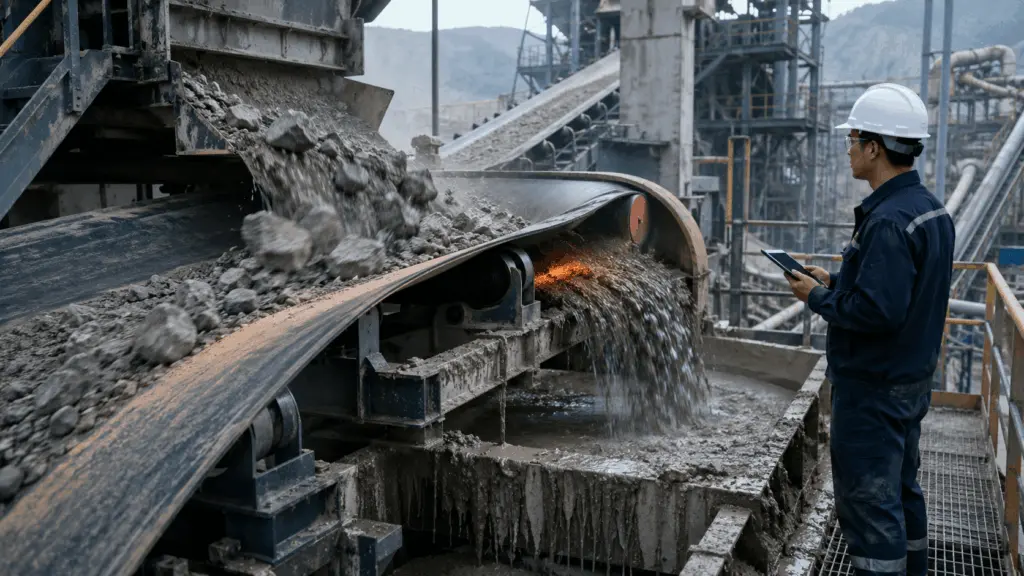
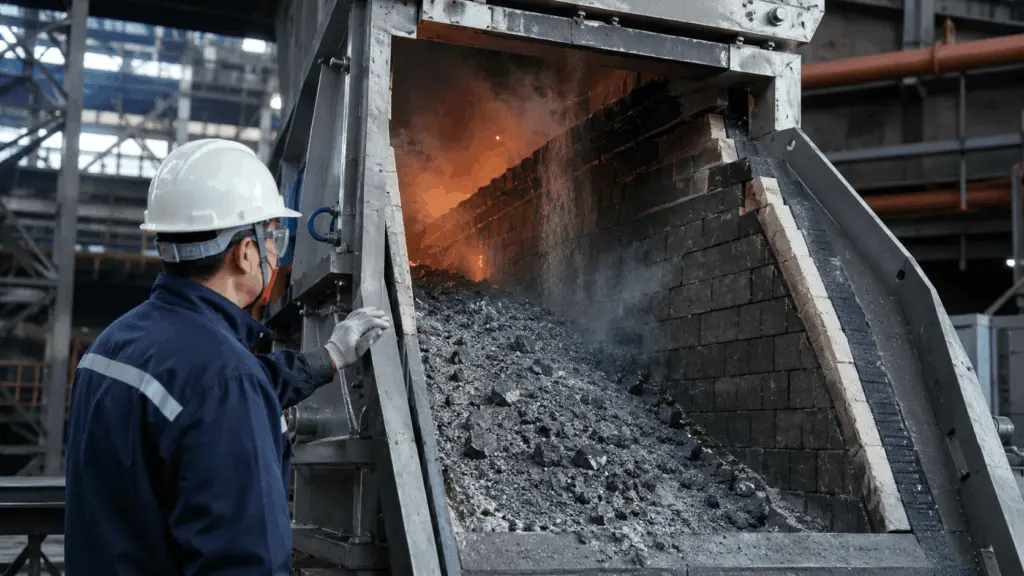
At a discharge hopper in an integrated iron and steel plant, the wear-resistant steel lining had required repeated repairs. The material was not of poor quality, but the location was subjected to large, sharp-edged steel slag falling and directly impacting from above. Under these conditions, impact resistance became an important requirement alongside scratch resistance. When the material cracked and spalled off in sections, service life was no longer determined solely by hardness.
Therefore, selecting wear-resistant materials is not a matter of ranking materials from “good” to “poor.” Each location needs to be evaluated based on its actual operating conditions before narrowing down the suitable material groups.
1. Material selection is the process of matching operating conditions with material properties
A material group that is suitable for one location may not be suitable for another.
Even within the same production line, two locations only a few meters apart may require different solutions if particle size, temperature, impact level, moisture or the chemical environment changes.
The selection process therefore needs to consider two sides:
- actual conditions at the location
- material properties and operating limits
When these two sets of data are considered together, there is a technical basis for eliminating unsuitable options and retaining the material groups that should be evaluated further.
This approach also makes the decision traceable many years later. Instead of retaining only the name of a material grade, the records can also show why that material was selected and which operating conditions formed the basis of the decision.
2. The role of four influencing factors in material selection
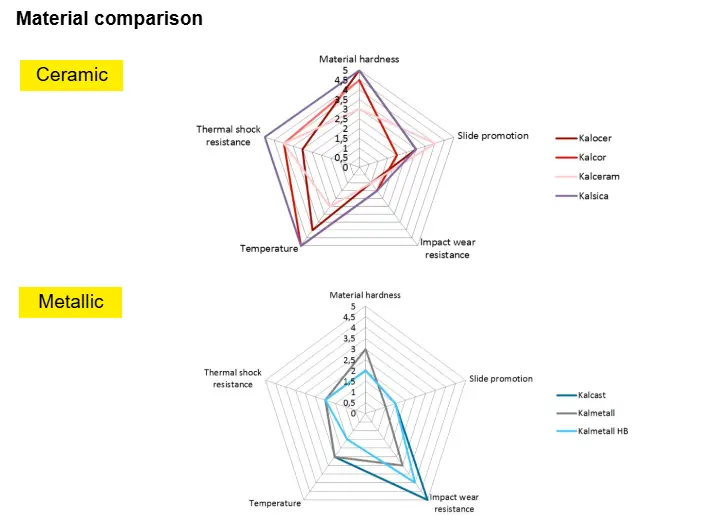
Four factors should be considered:
- wear
- temperature
- impact
- corrosion
However, these four factors should not be treated equally.
This sequence forms a filtering process.
Temperature is checked first because it can eliminate an entire material group. Wear then establishes the minimum hardness requirement, while impact limits the level of hardness that can be used. Finally, corrosion further narrows the remaining options according to the actual chemical environment.
If the hardness required by the wear conditions is higher than what the impact conditions can tolerate, a single material may not satisfy both requirements. In that case, it may be necessary to combine multiple material groups or modify the conditions acting on the location.
3. Material properties, test methods and the selection framework should be considered separately
A value in a technical data sheet is only meaningful when it is clear which property it describes, how it was determined and at what declaration level the manufacturer provides it.
Three layers of information should be distinguished:
Hardness, impact toughness and tensile properties cannot be used interchangeably.
Similarly, guaranteed values, typical values and converted values do not have the same evidential value.
A typical value may be useful for technical comparison, but it does not automatically become an acceptance criterion.
This topic is discussed in detail in Part 1: Material properties and trade-offs in material selection.
4. Material hardness should be compared with the hardness of the abrasive particles
In mechanical wear applications, comparing two materials with each other still leaves out one important piece of information: the hardness of the particles acting on the surface.
If the abrasive particles are harder than the material surface, they can still scratch the surface and remove material.
The assessment should therefore compare:
hardness of the abrasive particles ↔ hardness of the material surface
Particle hardness can be initially assessed in the field using the Mohs scale.
The hardness of engineering materials, meanwhile, may be specified using Brinell, Vickers or Rockwell scales depending on the material type and test method.
These scales should not be converted arbitrarily and then treated as direct measurements of one another.
How to interpret hardness, toughness and the trade-off between these two properties is discussed in Part 1: Material properties and trade-offs in material selection.
5. The selection process does not always result in only one material group
After the filtering process, the result usually falls into one of four situations:
Having two or three material groups remaining does not mean the selection process has failed.
Several options may all be technically suitable but differ in installation method, repairability, expected service life or cost of use.
Conversely, if no material group satisfies all operating conditions, searching for a more “advanced” material may not solve the problem.
6. Equipment geometry and installation feasibility may eliminate an option that meets the mechanical-property requirements
A material group may meet the requirements for hardness, temperature and impact but still be impractical at the actual location.
Additional factors that need to be checked include:
- surface geometry
- welding accessibility
- rear-side accessibility
- removal requirements for maintenance
- curing time
- available downtime
- lining fixing method
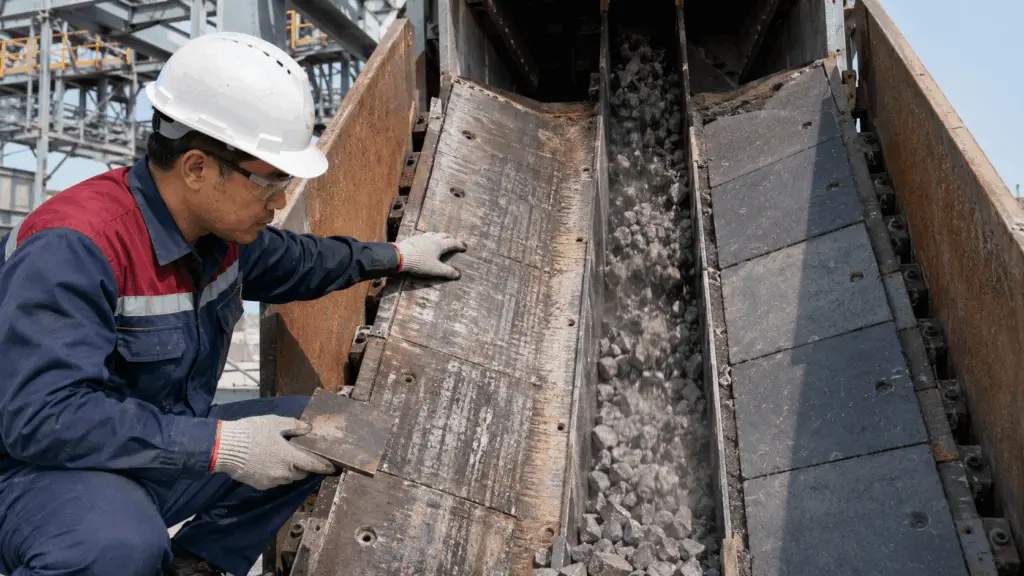
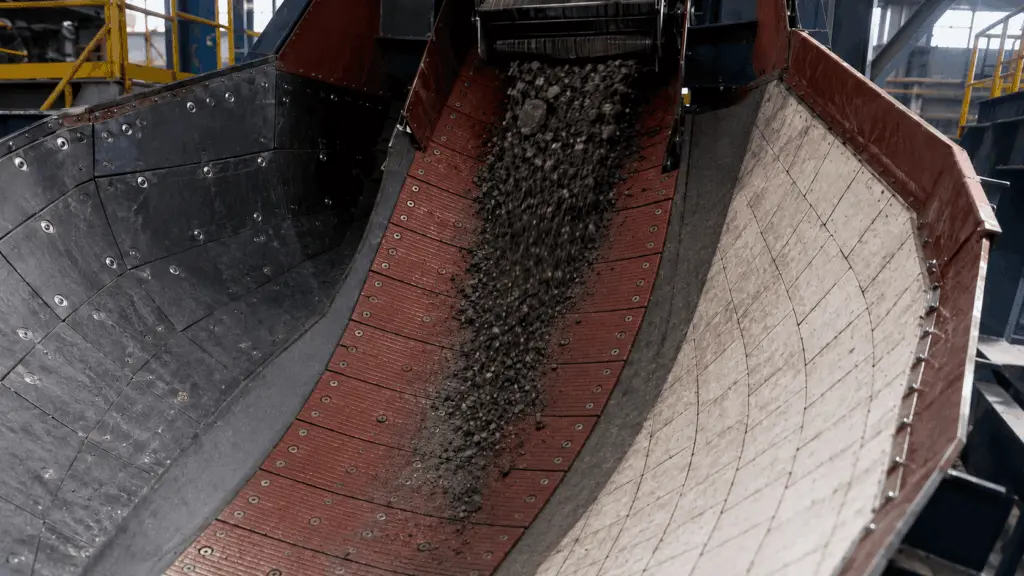
Metallic materials, hard non-metallic materials, monolithic linings and anti-adhesion materials differ not only in their material properties, but also in how they are fixed, repaired and how they fail.
This topic is discussed in detail in Part 3: Metallic, non-metallic and monolithic linings: selection based on geometry and installation.
7. Material adhesion and flow blockage require a separate selection process
When bulk material accumulates on the surface instead of gradually wearing away the lining, increasing hardness is no longer the appropriate selection logic.
The assessment needs to shift toward:
- material moisture
- interaction between the bulk material and the surface
- anti-adhesion performance
- sliding surface angle
- flow geometry
A very hard surface does not necessarily help moist bulk material slide more easily.
Conversely, a softer material group with more suitable surface characteristics may perform better in a material-flow application.
The selection logic for this situation is discussed in Part 4: Selecting anti-adhesion materials for material build-up and flow blockage.
8. One location may require multiple material groups
A component does not always operate under the same conditions across its entire surface.
For example:
- one zone may be exposed to impact
- one zone may experience sliding abrasion
- one zone may operate at a higher temperature
- one zone may need to be removable for maintenance
In such cases, using the same material across the entire component may not be the most appropriate solution.
When multiple material groups are combined at one location, the interface between them becomes a separate technical consideration.
Gaps, differences in surface level, flow direction, thermal expansion and installation sequence all need to be controlled.
This topic is covered in Part 5: Combining multiple materials at one location: design principles and interface control.
9. Changing materials only creates value when it changes the operating outcome
Longer service life does not automatically create greater value.
If the current material lasts 10 months and the new solution lasts 12 months in a plant with a planned shutdown every six months, both may still need to be replaced during the same shutdown.
Conversely, if service life increases enough to pass through one additional shutdown cycle, the plant may eliminate one intervention.
Service life should therefore be considered together with:
- maintenance cycle
- downtime
- remaining equipment life
- replacement frequency
- risk of unplanned downtime
It is also necessary to determine whether the actual cause lies in flow design, incorrect material function or insufficient input data.
These situations are discussed in Part 6: Cases where material replacement is not recommended.
10. Certain operating conditions may change the selection sequence
For most applications, the selection process can begin with the operating conditions.
However, some applications require mandatory conditions or compliance requirements to be checked first, including:
- direct food contact
- extremely high temperatures
- highly corrosive chemical environments
- fire-resistance requirements
A material may meet the mechanical requirements but still be unsuitable for use if the required documentation or certification for the application is missing.
Once the material scope has been narrowed according to these mandatory requirements, the selection process can continue based on temperature, wear, impact and corrosion.
This topic is covered in Part 7: Material selection for special operating conditions.
11. The eight in-depth articles in the material selection principles knowledge series
The Material Selection Principles knowledge series consists of eight in-depth articles.
The series moves from understanding material properties and filtering by operating conditions to installation feasibility, special applications and implementation pathways.
Part 1: Material properties and trade-offs in material selection
This article explains the meaning of hardness, impact toughness and tensile properties, while distinguishing between guaranteed values, typical values and converted values.
It also examines the trade-off between hardness and toughness, how to read technical data sheets, and how to compare material hardness with the hardness of abrasive particles.
Part 2: Four influencing factors and the material selection sequence
This article presents the complete filtering process based on temperature, wear, impact and corrosion.
It explains the role of each factor, how minimum and maximum hardness requirements are established, and what to do when several material groups remain or when no single group satisfies all requirements.
Part 3: Metallic, non-metallic and monolithic linings: selection based on geometry and installation
This article examines the differences between material groups in terms of applicable geometry, fixing methods, repairability and installation conditions.
It helps determine whether a solution can actually be implemented on the equipment before moving to a specific material grade.
Part 4: Selecting anti-adhesion materials for material build-up and flow blockage
This article shifts the selection logic from wear resistance to supporting material flow and reducing surface build-up.
It focuses on moisture, surface characteristics, sliding angle and applications that require both wear resistance and anti-adhesion performance.
Part 5: Combining multiple materials at one location: design principles and interface control
This article examines situations where one material group is not sufficient for the entire surface.
The main focus is the interface between materials, including gaps, level differences, installation sequence, waiting time and data that should be monitored after installation.
Part 6: Cases where material replacement is not recommended
This article evaluates cases where a material with longer service life may not create additional operational value.
It considers service life together with shutdown cycles, equipment life, design-related causes, material function and the completeness of input data before replacement is decided.
Part 7: Material selection for special operating conditions
This article focuses on applications where compliance requirements, certifications or mandatory operating conditions need to be checked before material properties are compared.
These situations include food contact, extremely high temperatures, highly corrosive chemicals and fire-resistance requirements.
Part 8: From field data to a material solution
This article connects the entire knowledge series into an implementation pathway based on the actual situation.
It helps determine the next step when dealing with repeated failures, preparing a purchasing proposal or designing new equipment.
12. Select the article according to the problem you are facing
13. Common deviations that can lead material selection in the wrong direction
14. From wear mechanism to material selection
Three knowledge groups are connected in sequence:
A material selection table is only useful when the input data accurately represents the actual operating location.
Identifying the mechanism helps determine what needs to be measured.
The field survey establishes the actual operating conditions.
Only then is there sufficient basis to filter, compare and select the appropriate material groups.
15. Notes on applying this knowledge
First, a material data sheet cannot by itself predict service life in a specific piece of equipment. Service life also depends on operating conditions and monitoring data from the actual location.
Second, material-group limits are suitable only for initial screening. Once the options have been narrowed down, the current technical documentation for the specific material grade under consideration must be checked.
Third, typical values, guaranteed values and converted values do not have the same evidential value. Parameters included in contracts or acceptance criteria need to be checked against the correct declaration level and test method.
Fourth, suitable material properties alone are not enough if the solution does not meet requirements for geometry, fixing method, installation feasibility or available downtime.
Fifth, when location-specific data is insufficient, the appropriate approach is to collect additional measurements or conduct a controlled trial rather than filling the gaps with assumptions.
The purpose of material selection principles is not to identify one “best” material for every application. The objective is to narrow the options from the actual operating conditions to material groups with suitable properties, operating limits and implementation feasibility, then compare service life, installation requirements and operational value before finalizing the solution.