Part 5: Combining multiple materials at one location: design principles and interface control
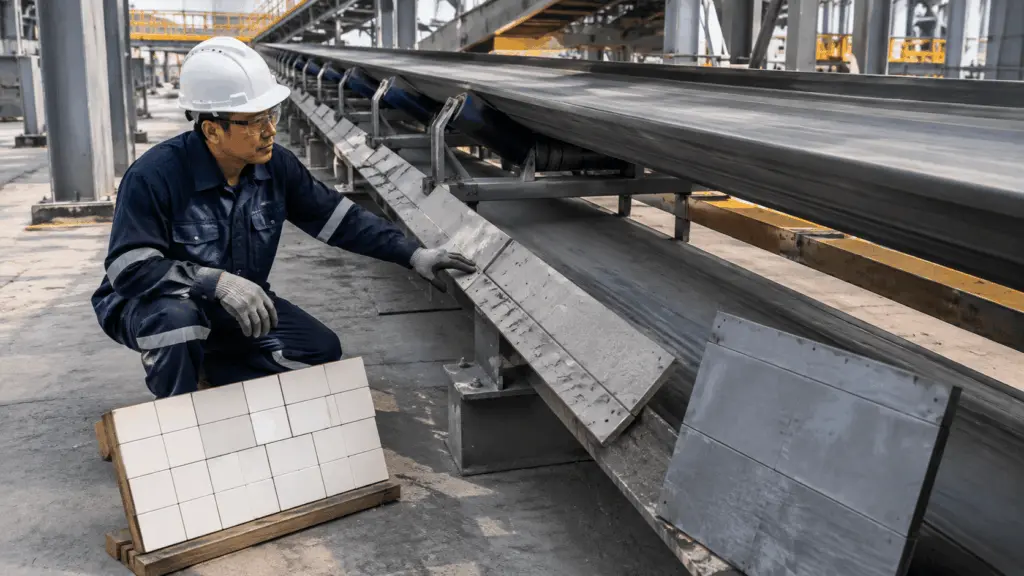
There are locations where a single material group cannot meet all operating requirements.
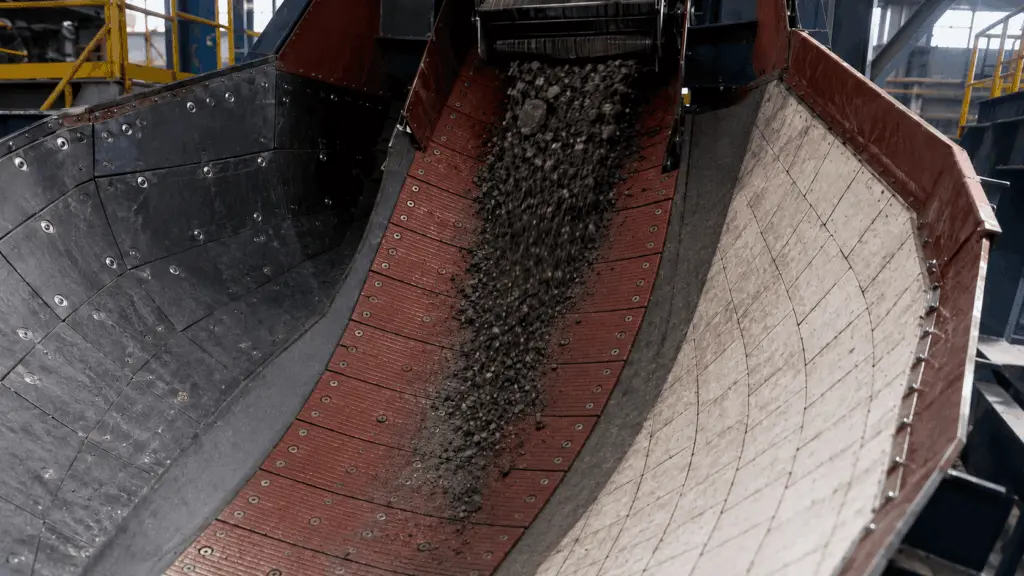
One area requires impact resistance, another is subjected to severe abrasion, while another operates at a higher temperature. In such cases, the solution may involve combining multiple material groups on the same component.
However, once two materials meet, the problem is no longer limited to the properties of each individual material. The interface between them becomes a separate engineering area that needs to be designed, installed, and monitored.
1. Combining materials when different areas of the same component operate under different conditions
One case discussed in Part 2 is when abrasion and impact requirements conflict.
Abrasion establishes a lower hardness limit to restrict particle cutting of the surface. Impact, on the other hand, establishes an upper hardness limit so that the material retains sufficient impact resistance.
If the lower hardness limit exceeds the upper hardness limit, a single material may not satisfy both requirements simultaneously.
In addition, the need to combine multiple materials may also arise when:
- temperatures differ significantly between areas of the same component
- one area needs to be removable for maintenance while another does not
Therefore, combining multiple material groups is not simply a matter of dividing the surface into smaller sections. The objective is to match each operating area with a material group suitable for the conditions of that specific area.
You can learn more about determining the lower and upper hardness limits and the material-screening sequence in Part 2: Four influencing factors and the material-selection sequence.
2. A single component may require as many as three material groups
The application documentation describes a case in which a coke wharf is divided into three operating zones:
A single component may have three zones, use three material groups, and require separate consultation of the technical documentation for each group.
An important point is that each manufacturer’s documentation primarily describes materials within that manufacturer’s own product scope.
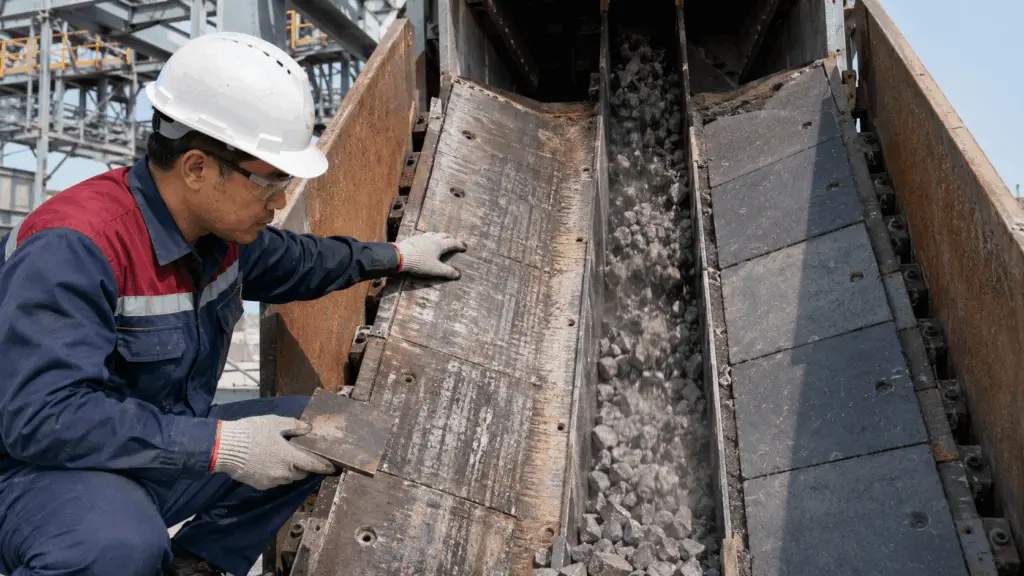
When different material groups are installed adjacent to one another, the interface becomes an area for which the designer must independently establish the design principles and verify them using actual data.
3. Six principles for combining multiple materials
When creating a new material combination, six principles need to be clearly maintained:
These six principles constitute a working framework, not a common standard applicable to every material combination.
The important point is that the availability of separate technical documentation for both materials does not mean that the interface between them has been verified.
4. Each new material combination requires data specific to that combination
Each individual material may already have complete technical specifications.
However, when two materials are placed next to each other on the same component, they form a new material combination with a new interface.
Data for each material considered separately are insufficient to describe the overall behavior of the combination, particularly at:
- interface gaps
- stepped transitions
- material edges aligned with the flow direction
- areas with differential thermal expansion
- locations subjected to direct impact from the material flow
Therefore, baseline data specific to that combination need to be established after installation.
These data allow subsequent evaluations to be based on measurements rather than requiring a return to the initial assumptions.
5. Information to be recorded in the material-combination documentation
A decision to combine materials should be retained as part of the technical documentation. The documentation needs to include the following information:
- actual conditions at the location, including measured factors and the source of each value
- material groups used
- the application area of each group on the component
- the reason for combining multiple materials
- installation conditions
- the person responsible for technical matters
- approval date and implementation date
Among these, the reason for combining materials is particularly important.
If, several years later, the documentation retains only the names of two materials but no longer contains information explaining why they were placed next to each other, subsequent evaluators will find it difficult to determine the conditions on which the original decision was based.
6. Three installation questions must be answered before installation
A material-combination solution is only complete when the installation sequence and transition zone have been clearly defined.
6.1. Which material group should be installed first?
The principle is to prioritize the group requiring the longer waiting time.
This allows curing or hardening time to run concurrently with the remaining work.
If the group requiring a shorter waiting time is installed first, followed by the group requiring prolonged curing, the entire longer waiting period may be pushed toward the end of the shutdown window.
As a result, the installation schedule may exceed the time permitted by the plant.
6.2. How much clearance is required at the interface?
The interface gap must simultaneously meet two requirements:
- provide sufficient clearance for thermal expansion
- not be so large that material becomes trapped in the gap
These two requirements act in opposite directions.
Therefore, the gap dimension should not be selected based on subjective judgment but must be determined from the requirements of the materials involved and the conditions at the actual location.
6.3. How long is the required waiting time between two installation stages?
If the two groups have different time requirements, the requirements of both need to be checked and the sequence arranged according to the more stringent requirement.
Before installation, the solution needs to provide clear written answers to:
- Which group should be installed first?
- What is the required interface gap?
- How long is the waiting time between the two installation stages?
If these three questions have not been answered, the material-combination solution remains incomplete.
7. Waiting times between material groups may differ significantly
Installation documentation for different material groups may specify substantially different time requirements.
The example above shows that a hard-compound system may require a significantly longer curing time than an adhesive system.
Therefore, the group requiring a longer waiting time should be scheduled early to make use of the available shutdown period.
However, the specifications of each individual material group do not fully resolve the material-combination problem. When two systems are installed adjacent to one another, it is still necessary to check whether the heat or operations involved in one installation stage may affect the other material group.
This must be verified on the actual material combination.
8. Three types of interfaces involve three different groups of risks
Not all interfaces between two materials are the same.
Among these three cases, stepped transitions are particularly easy to overlook.
Both materials may be suitable.
Both fastening methods may also be correct.
However, if their different thicknesses create an upstream-facing step, the interface itself may deteriorate before either material.
One direct inspection method is to examine the surface along the actual flow direction. If the transition forms a protrusion that obstructs the flow, that location needs to be reviewed before commissioning.
9. The interface requires separate measurement points
Measurements should not be taken only at the central areas of each material layer.
The transition zone is the area with the least available data and needs to be monitored separately after installation.
Three baseline data points need to be recorded:
- actual interface gap
- surface height difference between the two material groups
- close-up photographs of the transition zone with a reference scale in the same frame
These data help determine whether subsequent damage originates from:
- the material itself
- the fastening method
- or the transition zone itself
Without initial data, it will be difficult to determine the origin of the damage when the location deteriorates.
10. The material-combination decision requires a designated person with technical responsibility
Each manufacturer provides documentation and specifications for the materials within its own product scope.
When two materials from different sources are combined, it should not be assumed that either set of technical documentation covers the entire combination.
Therefore, the decision to create a new interface must have a clearly designated person with technical responsibility.
This responsibility does not replace the manufacturer’s responsibility for its own materials. The objective is to establish who is responsible for the material-combination decision, interface geometry, and the conditions governing the combination of the two material groups.
The documentation needs to retain this information so that it can be traced when evaluating performance or investigating failures in the future.
11. Responsibilities of the departments
The person formally responsible for the material-combination decision plays a particularly important role.
Because the new combination is not fully covered by a single manufacturer’s documentation, the decision requires clear technical responsibility and traceable documentation.
12. Notes when applying this knowledge
First, the six principles in this article are a working framework for organizing material-combination decisions, not a general guarantee applicable to every combination.
Second, each new combination still needs to be measured. Data from a previous combination do not automatically validate a new combination if the materials, geometry, or operating conditions have changed.
Third, parameters such as interface gaps, waiting times, and installation requirements must be obtained from the current technical documentation of the materials involved and the conditions at the actual location.
Fourth, the interface needs to be treated as a separate engineering area. Two individually suitable materials may still create a new failure point if differences in surface height, gaps, or transition direction are not properly addressed.
Combining multiple materials is meaningful only when each area is matched with a suitable material group and the interface is designed as a separate engineering element. Having suitable materials on both sides is not enough; the gap, surface height difference, installation sequence, waiting time, and post-installation data determine whether the combination operates as steadily as expected.