
FAQs
Bi-metal wear plate is recommended when a uniform alloy layer thickness and consistent hardness are required. Compared with on-site hardfacing, it provides more stable service life while reducing maintenance time.
For high-temperature applications, Hardox® HiTemp (300°C–500°C) or KALMETALL W145 (up to 750°C) is recommended. For acidic environments, Hardox® HiAce provides outstanding resistance to chemical corrosion, with performance comparable to stainless steel in many applications.
Hardox® 500 TUF combines high hardness (475–505 HBW) with exceptional toughness. Field measurements show that 16Mn steel wears approximately 4.47 times faster than Hardox® 500 TUF and is much more susceptible to cracking and permanent deformation.
KALMETALL W100 is manufactured using the Metal-Arc Process, which distributes ultra-hard chromium carbide particles uniformly throughout the entire wear layer. In contrast, conventional flux-cored hardfaced steel has carbide particles concentrated mainly near the surface due to dilution during welding, resulting in lower wear resistance and shorter service life.
The DIN 50320 standard provides a scientific framework for accurately evaluating the interactions among the four key system elements, ensuring that every recommended solution is based on sound engineering principles.
Not all wear problems have the same root cause. Even within the same piece of equipment, different areas may be subjected to sliding abrasion, impact, high-velocity material flow, elevated temperatures, or chemical attack.
Simply replacing the existing material with a harder one without identifying the actual wear mechanism may not improve equipment life and can even create additional failure modes.
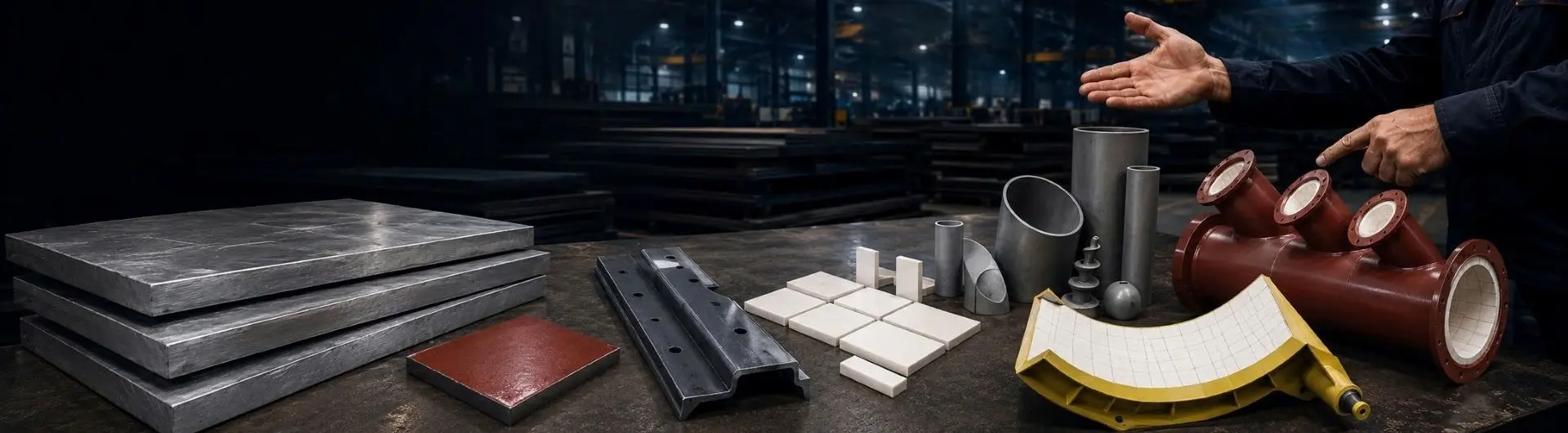
Gia Anh follows a diagnosis-first approach. Our engineers conduct on-site inspections, analyze operating conditions and wear mechanisms, and then recommend the most suitable lining material for each individual location instead of applying a one-material solution across the entire system.
It balances the service life of individual components, reduces localized replacement frequency, and minimizes the customer’s total operating costs.
Multiple materials should be combined whenever different areas of the equipment are exposed to different wear mechanisms. Each location should be protected with the material best suited to its actual operating conditions.
The four most common wear mechanisms are abrasion, impact, chemical corrosion, and material fatigue. A single piece of equipment may be exposed to several of these mechanisms simultaneously.
No. Wear-resistant steel is only suitable for specific operating conditions. In many applications, ceramic linings or combined lining solutions provide better performance and significantly longer service life.
A comprehensive assessment should include the base material, conveyed material, flow velocity, impact force, temperature, and operating environment. GAC applies wear mechanism analysis to determine the root cause before recommending the most appropriate solution.
Each location operates under different conditions, including impact forces, material flow velocity, temperature, and chemical exposure. Using the same lining material throughout the entire system may cause certain areas to fail much earlier than others.

Request Solution Consultation
Speak directly with our experienced engineers for a free site assessment and consultation on the most suitable solution
Key Clients


